


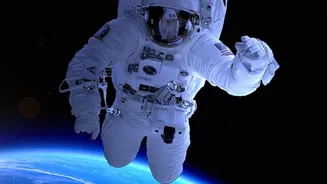
The Lethal Emptiness of the Vacuum
The most immediate threat in space is the vacuum itself. Here on Earth, we live under a constant, comfortable blanket of atmospheric pressure. In space, that pressure is gone. If you were exposed, the first and most critical effect would be on your lungs.
Instinct might tell you to hold your breath, but this would be a fatal mistake. The air trapped in your lungs would expand dramatically, causing them to rupture in a process called barotrauma. Instead, the body's only chance, however slim, relies on exhaling immediately. But even then, the lack of external pressure causes a terrifying reversal. The vacuum would start pulling gases, including the vital oxygen, directly out of your bloodstream through your lungs. Deprived of oxygen, you would lose consciousness in about 10 to 15 seconds. This rapid onset of hypoxia is the primary reason survival time is measured in seconds, not minutes.
The Myth of Exploding Bodies
Contrary to gruesome cinematic portrayals, a human body would not explode in space. While the pressure difference is extreme, our skin is remarkably strong and elastic, capable of containing our internal organs. However, a disturbing process called ebullism would occur. In the near-vacuum, the boiling point of liquids plummets. Since the human body is about 60% water, this means the moisture on your tongue, in your eyes, and the water within your soft tissues would begin to boil at body temperature. This would cause the body to swell grotesquely, perhaps to twice its normal size, as water vapour bubbles form in the fluids and blood. While you wouldn't explode, this swelling would be severe, and the gas bubbles would obstruct blood flow, contributing to circulatory failure.
An Assault of Extreme Temperatures
Space is a world of savage temperature extremes. If you were floating in direct sunlight in Earth's orbit, you'd be exposed to temperatures as high as 120°C. If you were in shadow, the temperature would plummet to around -100°C. Without an atmosphere to transfer heat, you wouldn't instantly freeze or fry. Heat transfer in a vacuum primarily happens through radiation, which is a slower process. The most immediate thermal shock would be from the rapid evaporation of moisture from your skin, mouth, and respiratory tract, which would cause these surfaces to cool to near-freezing temperatures very quickly. Over a couple of minutes, your body would lose heat to the void, but you would have already succumbed to oxygen deprivation long before freezing solid.
The Invisible Threat of Radiation
Even if you could somehow survive the pressure and temperature, space is flooded with invisible dangers. Without the protection of Earth's atmosphere and magnetic field, an unprotected body would be blasted by high-energy radiation. This includes solar particle events (SPEs) from the sun and a constant shower of galactic cosmic rays (GCRs) from deep space. This isn't a slow, long-term risk; the exposure would be intense enough to cause severe sunburn-like injuries almost immediately. This radiation damages DNA and can cause acute radiation sickness, leading to symptoms like nausea and damage to the central nervous system. While hypoxia or ebullism would likely be the cause of death, the intense radiation field is another layer of hostility that makes a spacesuit absolutely essential for survival.