




As smog season returns, many of us reach for an air purifier to protect our homes. But simply plugging one in isn't enough. For it to truly work, its capacity must be correctly matched to your room, a crucial step most people overlook.
Why Size Is the Most Important Spec
When buying an air
purifier, it's easy to get lost in features and marketing claims. But the single most important factor for effectively cleaning a room is choosing a unit designed for that specific space. An undersized purifier will struggle to clean the air, running constantly on high speed while failing to reduce pollutants like the dangerous PM2.5 particles found in smog. This leads to a false sense of security, higher electricity bills, and more frequent filter replacements. Conversely, a massively oversized unit can be unnecessarily loud and expensive for the space it's in. The goal is to find the 'just right' fit, ensuring the air is cleaned efficiently without wasting power or creating excessive noise.
Decoding the Jargon: What is CADR?
The key to correct sizing is a metric called the Clean Air Delivery Rate, or CADR. This standard rating, often measured in cubic metres per hour (m³/h), tells you the volume of filtered air a purifier can deliver. Think of it as the machine's horsepower; a higher CADR means the purifier can clean a larger space faster. When comparing models, CADR is the most reliable indicator of performance because it combines two critical elements: how much air the fan moves and how effectively the filter cleans it. Always look for the CADR rating to make an informed comparison between different units.
The Two-Thirds Rule: A Simple Sizing Guide
A widely accepted guideline for choosing the right purifier comes from the Association of Home Appliance Manufacturers (AHAM). Known as the 'two-thirds rule', it provides a straightforward way to match a purifier to your room. The rule states that the purifier's smoke CADR rating (in CFM, or cubic feet per minute) should be at least two-thirds of the room's area in square feet. For example, a 150-square-foot bedroom would need a purifier with a CADR of at least 100 CFM. Since smoke particles are among the smallest and hardest to trap, a purifier that can handle them will have no trouble with larger particles like dust and pollen. For homes in India, where CADR is often listed in m³/h, a good rule of thumb is to multiply your room's square footage by 0.85 to find the minimum required CADR in m³/h.
Air Changes Per Hour: The Key to Beating Smog
Beyond CADR, another important concept is Air Changes per Hour (ACH). This tells you how many times the purifier can clean the entire volume of air in a room within one hour. For general air cleaning, 2–3 ACH might be acceptable. However, during heavy smog or for households with allergy sufferers, a minimum of 4–5 ACH is recommended for a meaningful reduction in pollutants. Achieving 5 ACH means the air in your room is being completely filtered roughly every 12 minutes, which is crucial for keeping PM2.5 levels low when outdoor air quality is poor. Many manufacturers list a 'recommended room size' based on a low ACH of just 1 or 2, so it's vital to calculate it yourself to ensure you're getting the protection you need.
Putting It All Together: A Practical Checklist
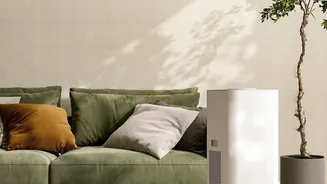
To find the perfect purifier, follow these steps. First, measure your room's length and width to get its square footage. Don't just guess; be precise. Second, use this area to calculate your target CADR, aiming for at least 5 ACH if smog is your primary concern. Third, insist on a True HEPA filter. Labels like 'HEPA–type' or 'HEPA–style' do not meet the same standard and are less effective at capturing the ultra–fine PM2.5 particles that make smog so dangerous. Finally, once you have your purifier, placement matters. Keep it away from walls or furniture to ensure good airflow, and always run it with the windows and doors closed to prevent polluted outdoor air from getting back in.