
Why Venus? Earth's cautionary tale
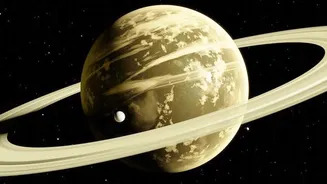
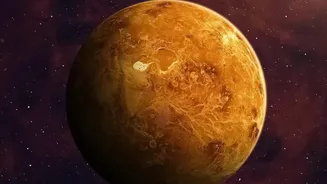
Venus is often called Earth's twin, but it's more like an evil twin. While similar in size, mass, and composition, it evolved into a planetary nightmare. Its atmosphere is a crushing blanket of carbon dioxide, over 90 times denser than Earth's, creating
a runaway greenhouse effect that pushes surface temperatures to a lead-melting 475°C. The planet is perpetually covered by thick clouds of sulfuric acid, making its surface invisible to standard telescopes. Scientists believe Venus may have once been habitable, perhaps with oceans like Earth's. Understanding what went so catastrophically wrong there could provide invaluable lessons about planetary evolution and climate change, offering a glimpse into a potential future for our own world. This is why global interest in Venus has surged, with multiple agencies planning missions to uncover its secrets.
The mission's ambitious goals
Approved by the Union Cabinet in September 2024 with a budget of ₹1,236 crore, the Venus Orbiter Mission, unofficially known as Shukrayaan, has a clear set of ambitious objectives. The primary goal is to conduct a comprehensive global survey of Venus. This involves investigating its surface and shallow subsurface, studying the composition and dynamics of its toxic atmosphere, and examining the interaction between the planet and the solar wind. ISRO scientists want to understand the processes that led to Venus’s dramatic transformation. The mission will also hunt for active volcanic hotspots and lava flows, which could reveal whether the planet is still geologically active today. These observations will create a holistic picture of Venus, from its hidden geology to its super-rotating cloud systems.
Peering through the clouds: The key sensors
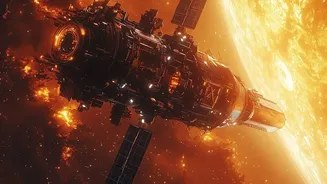
The biggest challenge in studying Venus is its opaque atmosphere. To overcome this, Shukrayaan’s star instrument is a high-resolution Synthetic Aperture Radar (SAR). Unlike optical cameras, radar can penetrate the thick cloud cover to map the planet's surface in remarkable detail, day or night, and in any weather. This instrument is an improved version of the one used on the Chandrayaan-2 lunar orbiter and is expected to provide images with much higher resolution than NASA's Magellan mission in the 1990s. In a first for Venus exploration, the mission will also carry a ground-penetrating radar to investigate the subsurface, searching for buried geological structures and clues to the planet’s history. Other payloads include instruments to analyze the atmosphere and study how solar radiation interacts with Venus's ionosphere, with some developed in collaboration with international partners like Sweden.
A journey to a hostile world
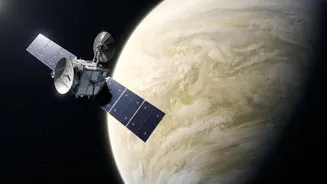
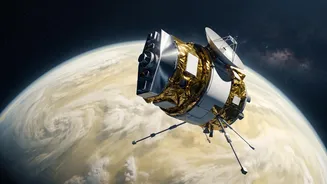
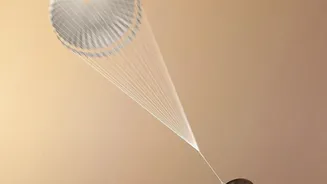
Exploring Venus is one of the toughest challenges in the solar system. The surface conditions are extreme: the atmospheric pressure is equivalent to being 900 meters underwater on Earth, capable of crushing most landers. The scorching temperatures can melt electronics and render spacecraft useless in minutes. The longest any probe has survived on the surface is just over two hours, a record set by the Soviet Venera 13 probe in 1982. For this reason, Shukrayaan is an orbiter mission, designed to study the planet from a safe distance. Planned for launch on March 29, 2028, aboard ISRO’s powerful LVM-3 rocket, the spacecraft will embark on a 112-day journey. Upon arrival, it will enter a large elliptical orbit, ranging from 500 km to 60,000 km, allowing its instruments to gather data from various altitudes over a planned four-year mission duration.