





Myth: AI Will Take All Our Jobs
This is the biggest and most persistent fear, but it's a significant oversimplification. While AI is certainly automating specific tasks, it doesn't equate to eliminating entire jobs. Most roles are a collection of various tasks, and AI is currently good
at handling the repetitive, data-heavy ones. Recent analysis shows that job roles are being reshaped, not erased. The World Economic Forum projects that while millions of tasks may be displaced, even more new roles will emerge that require a new division of labour between humans and machines. Think of it less as replacement and more as transformation. AI is freeing up professionals to focus on the parts of their job that require uniquely human skills: strategic thinking, complex problem-solving, and emotional intelligence.
Myth: You Must Become a Coder to Survive
While demand for technical AI skills like machine learning and programming is high, the idea that everyone needs to become a developer is misleading. In reality, there's a growing emphasis on two distinct skill sets: technical AI skills for building models and non-technical AI literacy for using them effectively. For most professionals, the latter is far more crucial. This means learning how to use AI tools to do your existing job better, a practice known as augmentation. The most valuable employees are often those who combine their deep industry knowledge with an ability to leverage AI. Furthermore, as AI handles more technical tasks, soft skills like communication, critical thinking, creativity, and collaboration become even more valuable differentiators.
Myth: My Industry is 'Safe' from AI's Impact
Some believe that AI's impact is confined to tech, data-heavy, or administrative roles. Conversely, others believe creative or physical jobs are immune. Both assumptions are flawed. Recent reports show that AI exposure is broad, with adoption highest in sectors like Management, Information, and Professional Services. Creative fields like marketing and design are seeing entry-level tasks automated, while robotics are increasingly used in manufacturing and logistics. The reality is that no industry is entirely insulated from change. The key isn't to find a 'safe' industry but to cultivate an adaptable mindset. The professionals who thrive will be those who embrace continuous learning and see AI not as a threat to their field, but as a powerful tool to be mastered.
Myth: It's a Race of Humans Against Machines
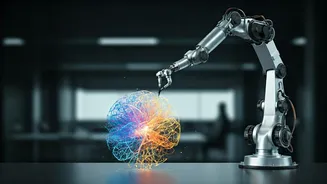
Framing the rise of AI as a competition is both stressful and counterproductive. The most successful professionals and companies are not trying to out-compete AI; they are learning to collaborate with it. The goal is to move from simply doing your job to designing how your job gets done, using AI as a partner. This involves identifying tasks that can be automated, using AI to generate insights, and then applying your human judgment and expertise to make strategic decisions. Companies are discovering that the biggest productivity gains come when AI is used to augment human capabilities, not just to cut costs. Your career advantage in the coming years won't come from being faster than a machine, but from being better at working with one.