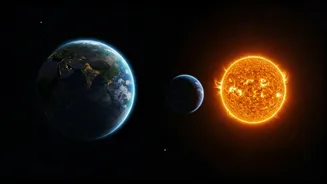










The Great July Paradox
It feels like a riddle: How can it be so hot when we are so far from the heat source? On July 6, 2026, Earth reaches a special point in its orbit called 'aphelion'. The name comes from the Greek words 'apo' (away) and 'helios' (sun), and it literally
means the moment our planet is at its maximum distance from our star. This year, that distance will be over 152 million kilometres. Compare that to early January, when Earth is at 'perihelion' (closest to the Sun), at a distance of about 147 million kilometres. That’s a difference of around five million kilometres. It seems logical to think that farther away means colder, yet the Northern Hemisphere, including all of India, is experiencing its summer season. This apparent contradiction is one of the most elegant examples of how our planet’s climate system works, and the answer isn't about distance at all.
It's Not the Proximity, It's the Pose
The true reason for the seasons is not our planet’s slightly elliptical orbit, but its tilt. Earth spins on an axis that is tipped over by about 23.5 degrees. This tilt is the undisputed main character in the story of our seasons. As Earth makes its annual journey around the Sun, this axis consistently points in the same direction in space. For about half the year, the Northern Hemisphere is tilted towards the Sun, and for the other half, it’s tilted away. When our hemisphere is tilted towards the Sun, as it is in July, we receive sunlight more directly and for longer periods each day. Think of it like a torch: a beam shone directly at a surface is concentrated and intense, while a beam shone at an angle is spread out and weaker. Summer happens when your part of the world is getting those direct, concentrated rays of sunlight, leading to warmer temperatures. Winter is the opposite; the same amount of solar energy is spread over a larger area, reducing its heating effect.
Direct Hits of Sunshine
The length of our days is also a critical factor. During the summer, the hemisphere tilted toward the sun not only gets more direct rays but also experiences longer daylight hours. This gives the Sun more time to heat the land, air, and oceans. The combination of more direct energy and longer exposure is what drives summer heat. In the winter, the days are shorter and the sun's rays are less direct, giving the surface less time to heat up and more time to cool down overnight. The summer solstice, which occurs in late June, marks the day with the most daylight hours in the Northern Hemisphere and the moment our tilt towards the sun is at its maximum. Aphelion follows just a couple of weeks later, beautifully illustrating that the power of direct, sustained sunlight easily overpowers the minor effect of being a few million kilometres farther away.
So, Does Distance Matter At All?
While the axial tilt is the star of the show, the varying distance to the Sun does play a minor, supporting role. The change in distance means that Earth receives about 7% less intense sunlight at aphelion in July compared to perihelion in January. One interesting consequence of this is that it moderates the seasons in the Northern Hemisphere. Our summers are slightly cooler than they would be otherwise, and our winters are slightly warmer. Conversely, the Southern Hemisphere, which has its summer during perihelion (closest to the sun), experiences slightly more intense summers. However, this effect is largely balanced out because the Southern Hemisphere is predominantly covered by water, which heats up and cools down more slowly than land. Furthermore, according to Kepler’s laws of planetary motion, Earth moves slightly slower in its orbit when it is farther from the sun. This means that summer in the Northern Hemisphere is actually a few days longer than summer in the Southern Hemisphere.