



What Exactly is a Cool Roof Coating?
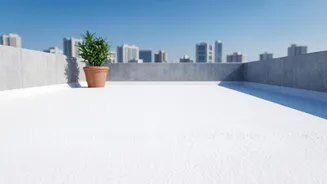
Think of a cool roof coating as powerful sunscreen for your house. It’s a thick, liquid-applied layer, usually white or light-coloured, that is designed to reflect sunlight away from your roof instead of absorbing it. A standard dark or concrete roof can
absorb up to 80% of the sun's energy, converting it into heat that radiates down into your home. A cool roof does the opposite. By using special pigments that are highly reflective, these coatings can bounce back 70% to 85% of solar radiation. This simple principle is measured by the Solar Reflectance Index (SRI), where a higher number means a cooler roof. While regular white paint offers some benefit, specially formulated cool coatings are engineered to reflect infrared radiation—the part of sunlight that generates the most heat—far more effectively.
The Science of Staying Cool
The effectiveness of cool roof coatings relies on two key properties: solar reflectance and thermal emittance. Solar reflectance is the ability to reflect sunlight. As explained, a white T-shirt stays cooler in the sun than a black one because it reflects more light; cool roofs operate on the same principle. Thermal emittance is the surface's ability to radiate away the heat that it has absorbed. Most modern cool roof coatings, which include acrylic, silicone, and polyurethane types, excel at both. By reflecting most of the sun's rays and efficiently releasing what little heat is absorbed, the roof surface itself can stay significantly cooler. Studies in Indian cities have shown that while an untreated concrete roof can reach surface temperatures of 65-70°C in peak summer, a coated roof stays closer to 45-48°C. This massive reduction in surface heat means less warmth is transferred through the roof slab into the rooms below.
Tangible Benefits for the Indian Home
The most immediate benefit is increased indoor comfort. Pilot programs and studies in Indian cities like Ahmedabad, Jodhpur, and Hyderabad have consistently shown that applying a solar reflective paint can lower indoor temperatures by 2°C to 5°C. In some cases, with optimal conditions, the reduction can be even greater. This drop in temperature directly translates to lower electricity bills. With less heat entering the home, air conditioners and fans don't have to work as hard, which can reduce cooling energy consumption by up to 25%. Beyond savings and comfort, these coatings also extend the life of your roof. By shielding the surface from harsh UV radiation and reducing the extreme temperature fluctuations that cause cracking, a cool roof coating acts as a protective barrier.
Breaking Down the 'Low Cost' Claim
Compared to major structural changes or high-end air conditioning systems, cool roof coatings are a highly affordable investment. The cost in India varies based on the quality of the paint, brand, and labour charges. Generally, homeowners can expect the material and application to cost between ₹20 and ₹45 per square foot. Some providers offer basic coating services starting from around ₹25 per square foot. For perspective, a traditional and much less durable solution like lime wash (chuna) costs around ₹5 to ₹10 per square foot but needs to be reapplied every year. While the initial outlay for a quality synthetic coating is higher, its durability and significant energy savings mean it often pays for itself within a few years.
Application, Maintenance, and Considerations
Applying a cool roof coating is a straightforward process, similar to painting. The roof surface is first cleaned thoroughly to remove dust, debris, and any loose material. For best results, two coats are typically applied—often in perpendicular directions to ensure full coverage. Maintenance is minimal but important; the roof should be cleaned periodically to prevent dirt and dust from covering the reflective surface and reducing its effectiveness. Most modern coatings are designed to be durable and can last for several years before a re-coat is needed. While highly effective, it's important to have realistic expectations. The biggest impact is felt in top-floor rooms directly under the treated roof, and its performance is best in hot, sunny climates. It is a tool for heat reduction, not a replacement for an air conditioner in extreme heatwaves.