




A Celestial Downpour of Ice and Organics
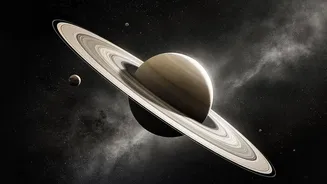
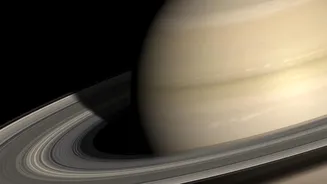
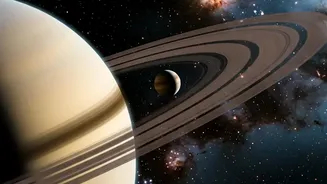
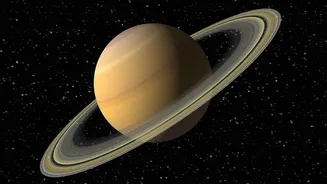
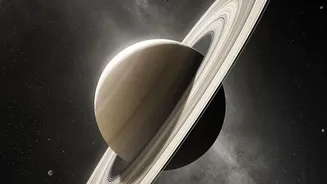
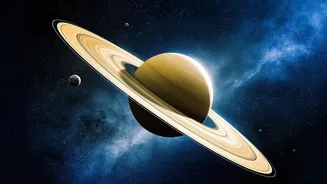
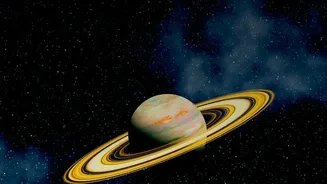
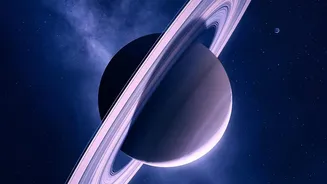
For decades, scientists have theorised about a phenomenon known as "ring rain," where particles from Saturn's rings fall into the planet's atmosphere. What was once thought to be a gentle drizzle is now understood to be a constant, heavy downpour. Data
from NASA’s Cassini spacecraft revealed that a staggering 10,000 kilograms of material cascade from the rings into Saturn every second. This isn't just a shower of water ice, which makes up the bulk of the rings. Cassini's instruments detected a complex cocktail of materials, including surprising organic compounds like butane and propane, alongside silicate dust and molecular hydrogen. This influx is far greater and more complex than anyone anticipated, transforming our understanding of the relationship between the planet and its famous rings.
Echoes From a Dying Explorer
Much of this groundbreaking insight comes from the final, daring phase of the Cassini mission. After 13 years of exploring the Saturnian system, the spacecraft performed a series of 22 dives into the previously unexplored gap between the planet and its innermost rings before making a final plunge into the atmosphere in 2017. During these 'Grand Finale' orbits, Cassini’s instruments directly sampled the particles flowing from the rings. This was a high-risk, high-reward maneuver that provided the first direct evidence of the composition of the ring rain. The data showed that this material significantly impacts Saturn's ionosphere, a charged layer in the upper atmosphere. The falling particles essentially "quench" the ionosphere, reducing the density of charged particles in the zones where the rain falls most heavily.
A New Eye on a Familiar Giant
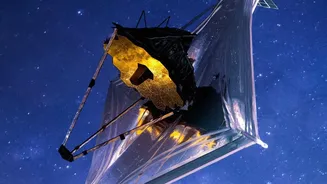
The investigation didn't end with Cassini. More recent observations from powerful tools like the James Webb Space Telescope (JWST) and the Hubble Space Telescope are adding new layers to the mystery. By observing Saturn in infrared wavelengths, which are invisible to the human eye, JWST can peer into the planet's atmospheric composition and temperature with unprecedented clarity. These observations have confirmed that the ring rain is heating Saturn's upper atmosphere. The constant bombardment of particles creates an excess of ultraviolet radiation, seen as a spectral line of hot hydrogen, proving that an external force is warming the planet from above. While Webb's deep looks have also revealed unexpected and currently unexplained features in Saturn's auroras, the primary story remains one of profound interaction.
The Ring's Surprising Influence
The consequences of this downpour are significant. The influx of water and other chemicals alters the composition of Saturn’s upper atmosphere, influencing its chemistry and temperature across vast regions. The material falling from the rings is being drawn along the planet's magnetic field lines, creating dark bands in Saturn’s otherwise uniform infrared glow. These shadowed areas, covering up to 43 percent of the upper atmosphere's surface, are where the ring rain neutralises the glowing ions. This dynamic interplay demonstrates that Saturn is not an isolated gas giant with a separate, passive ring system. Instead, it is a deeply interconnected system where the rings actively govern the climate and environment of the planet they encircle.
A Fleeting Cosmic Masterpiece
This discovery also carries a poignant implication: Saturn’s rings are temporary. The very process that feeds the planet is also destroying its most beautiful feature. Scientists have long debated the age of the rings, with evidence from Cassini suggesting they may be relatively young, perhaps only a few hundred million years old — meaning they may not have existed during the age of the dinosaurs. At the current rate of decay, the rings could be completely gone in another 100 to 300 million years. While this seems like an eternity in human terms, it's a fleeting moment on a cosmic timescale. It suggests we are lucky to be alive in an era when Saturn is at its most spectacular, a planetary icon dressed in a magnificent, but ultimately ephemeral, costume of ice and dust.