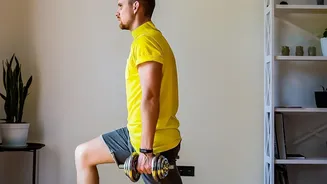







In the search for an exercise that builds real-world strength without needing a gym, the walking lunge stands out. This dynamic movement does more than just tone your legs; it builds the functional power you use every day.
The Power of Functional Fitness
The walking lunge is a powerhouse
of functional fitness, a type of training that prepares your body for real-life activities. Unlike exercises that isolate a single muscle, walking lunges engage multiple muscle groups at once, mimicking natural movements like climbing stairs, carrying groceries, or even just getting up from the ground. This dynamic, forward-moving lunge targets the quadriceps, hamstrings, glutes, and calves, while also forcing your core to work hard to maintain balance and stability with each step. By training your body as an integrated system, you build strength that is not only visible but, more importantly, useful in your daily life.
Your Step-by-Step Guide to Proper Form
Perfecting your form is crucial to reaping the benefits and avoiding injury. Stand with your feet hip-width apart, keeping your torso upright and your shoulders back and relaxed. Engage your core by drawing your belly button in, as if bracing for a light punch. Step forward with one leg, taking a stride that is longer than a normal walking step. Lower your hips until both knees are bent at approximately a 90-degree angle. Your front knee should be directly above your ankle, and your back knee should hover just above the floor without touching it. Drive through the heel of your front foot to rise, then bring your back leg forward to step directly into the next lunge with the opposite leg. The movement should be smooth and controlled, not rushed.
Common Mistakes to Avoid
Even a great exercise can be ineffective or risky if done incorrectly. One of the most common errors is allowing the front knee to collapse inward or extend past the toes, which puts unnecessary strain on the joint. To fix this, consciously track your knee over your second toe. Another frequent mistake is leaning the torso too far forward. This often happens due to a weak core or trying to use momentum. Keep your chest lifted and your gaze fixed a few feet in front of you to maintain an upright posture. Finally, avoid taking steps that are too short or too long. A stride that is too short limits glute activation, while overstriding can strain the hamstring and hip joints. Focus on achieving those 90-degree angles in both knees for the ideal step length.
Unilateral Training and Core Benefits
Because walking lunges are a unilateral exercise—meaning they work one side of the body at a time—they offer unique benefits. This single-leg focus challenges and improves your balance, coordination, and stability. It also helps to identify and correct muscle imbalances between your left and right sides, which can often go unnoticed during bilateral exercises like squats. Every step is a mini-challenge for your stabilizing muscles, especially in your core and hips (like the gluteus medius). A strong core and stable hips are foundational for almost every athletic movement and can help reduce the risk of lower back pain and other injuries.
Variations to Modify and Progress
The walking lunge is incredibly versatile. If you're a beginner, you might start with static lunges (stepping forward and then returning to the start) to master the form before adding the forward-walking component. For a gentler option, reverse lunges, where you step backward, tend to place less stress on the knees. Once you are comfortable with the basic walking lunge, you can add challenges. Holding dumbbells in each hand is a straightforward way to increase the load and build more strength. For an extra core challenge, you can add a torso twist at the bottom of each lunge, rotating your upper body toward your front leg. For advanced athletes, a jumping lunge can add an explosive, cardiovascular element to the workout.