






A Familiar Northern Puzzle
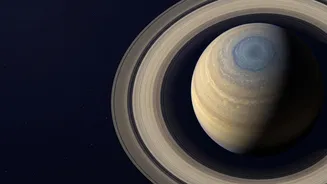
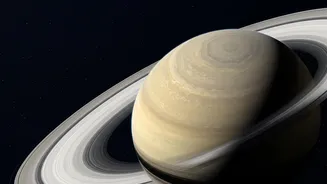
For over four decades, scientists have been captivated by a bizarre feature at Saturn's north pole. First spotted by the Voyager spacecraft in the early 1980s, it’s a colossal six-sided jet stream known simply as “the hexagon.” This isn't an optical illusion;
it's a real and persistent weather pattern wider than two Earths, with winds howling at over 320 kilometres per hour. For years, researchers from missions like Cassini treated it as a unique oddity, a spectacular fluke of planetary physics. While the north pole sported this perfect polygon, the south pole appeared to have a more conventional, circular vortex, leading many to assume the hexagon was a one-of-a-kind phenomenon.
An Unexpected Southern Counterpart
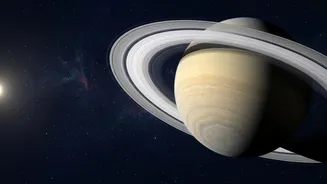
That assumption was shattered recently. As Saturn's long seasons changed, its south pole tilted back toward Earth, offering a view that had been obscured for years. In 2024, amateur astronomers noticed a faint, wavy pattern in ground-based images. Intrigued, professional researchers turned to the powerful Hubble Space Telescope. The high-resolution images confirmed the presence of a new, giant atmospheric wave with ten distinct sides. By reviewing archival data, scientists traced its emergence back to 2023, but no earlier. The Cassini spacecraft, which orbited Saturn from 2004 to 2017 and mapped the south pole extensively, saw no hint of this structure, confirming that the decagon is a brand-new development.
The Science of Planetary Polygons
So, how does a gas giant form a perfect polygon? The answer lies in the complex fluid dynamics of its atmosphere. These shapes are believed to be standing waves, or Rossby waves, locked within powerful jet streams. Imagine a fast-moving river of air; if conditions are just right, turbulence and pressure differences can cause the flow to bend into a stable, geometric pattern instead of a smooth circle. Scientists have even replicated the formation of hexagons and other polygons in laboratory experiments using rotating tanks of liquid. The Saturnian decagon is an atmospheric wave that extends deep into the planet's atmosphere, not just a feature on the cloud tops. This suggests it is a significant, vertically layered structure rooted in the planet's powerful weather systems.
A Mystery in the Making
While related to the northern hexagon, the southern decagon is distinctly different. It has ten sides instead of six and exists at a different latitude. More importantly, while the hexagon has been remarkably stable for over 40 years, the decagon appears to be actively evolving and strengthening. This gives scientists an unprecedented opportunity to watch a massive planetary storm system form in real-time. Researchers are still exploring why it formed now. One leading hypothesis suggests it may be influenced by a nearby, smaller storm—a 4,000-kilometer-wide anticyclone that researchers have dubbed a 'Red Spot', similar to Jupiter's famous storm. This neighbouring vortex could be forcing the jet stream into its ten-sided shape.
A New Chapter for Saturn
The discovery of the decagon fundamentally changes our understanding of Saturn. It suggests that forming giant polygons might not be a fluke but a fundamental behaviour of the planet's atmosphere under the right conditions. It shows that even planets we have studied for decades can surprise us, revealing a dynamic and ever-changing nature. The Cassini mission provided an incredible close-up view for 13 years, but its end left an observational gap. That gap is now being filled by the Hubble's Outer Planet Atmospheres Legacy (OPAL) program, which performs annual check-ups on our solar system's giants, ensuring we don't miss these fleeting, fascinating events.