






The Static Resume's Growing Inadequacy
The traditional resume is a static, one-dimensional summary of a person's past. It lists job titles, responsibilities, and self-reported skills. However, it often fails to provide concrete evidence of a candidate's actual abilities. Recruiters find it difficult
to gauge soft skills, problem-solving capabilities, or how a candidate truly performs under pressure based on a document alone. Studies and recruiters note that resumes are prone to exaggeration and keyword-stuffing, where applicants load their CVs with trendy terms simply to pass through initial automated screening systems (ATS). This creates a scenario where the best resume writer, not necessarily the best candidate, gets the attention. This format struggles to represent non-traditional career paths, such as those with employment gaps or freelance experience, often filtering out highly capable individuals before they get a chance.
Enter the Interactive AI Portfolio
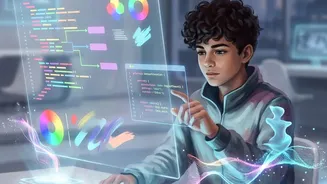
An interactive AI portfolio is a dynamic, digital collection of a candidate's work that demonstrates skills in action. Unlike a paper resume that tells, a portfolio shows. For a developer, this could be a link to their GitHub with live projects; for a designer, an interactive collection of their work; for a data scientist, a dashboard that visualizes a complex dataset. The 'AI' component comes into play in how these portfolios are created and assessed. AI tools can help candidates build these showcases without needing to be web developers themselves. More importantly, for recruiters, AI can analyze these portfolios to provide objective, data-backed insights into a candidate's competencies, from coding proficiency to communication style. This goes far beyond the simple keyword matching that defines traditional resume screening.
From 'Claimed Skills' to 'Demonstrated Ability'
The fundamental shift is from evaluating claimed skills to verifying demonstrated ability. A resume claims 'proficient in Python'; a portfolio shows a functioning application built with Python. This provides recruiters with tangible proof of what a candidate can deliver, significantly reducing the risk of a bad hire. Interactive portfolios allow for the assessment of both hard and soft skills. For example, a candidate might be asked to solve a problem in a simulated environment, allowing recruiters to observe their thought process, creativity, and resilience in real-time. This provides a much richer, more holistic view of the candidate than a bulleted list of past duties ever could. For talent acquisition teams, this means higher quality shortlists and a better prediction of on-the-job success.
The Trend in the Indian Job Market
This global trend is rapidly gaining traction in India, particularly within the booming tech, IT, and financial services sectors. A 2026 report from Deloitte highlighted that 86% of Indian organizations are now using AI in their recruitment processes, with a clear move towards skills-focused hiring. While resume screening is still a primary use case, the focus is evolving. With a massive volume of applicants for every skilled role, Indian companies are leveraging AI to move beyond the resume and identify top talent more efficiently. The demand for proven AI and data skills is so high that candidates possessing them can command salary premiums of 20-25%. For job seekers in India, this means that simply listing skills is no longer enough; demonstrating them through a well-curated portfolio is becoming essential to stand out.