






A Cosmic Weather Map
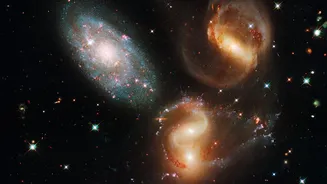
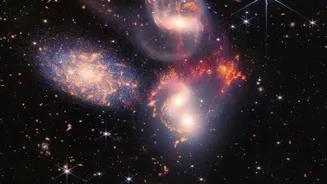
Imagine trying to take the temperature of a storm system millions of light-years away. That’s essentially what astronomers are now doing with galaxies. Recent observations, particularly from NASA's Chandra X-ray Observatory, are painting a new picture
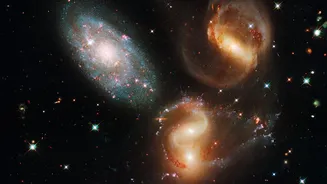
of galactic environments. These aren't calm, empty spaces between the stars; they are dynamic and chaotic arenas filled with multimillion-degree gas. For instance, in a galaxy cluster known as Zwicky 8338, located nearly 700 million light-years away, astronomers discovered enormous, comet-like tails of hot gas stretching over 1.6 million light-years. This superheated gas, stripped from galaxies as they speed through the cluster, creates a complex landscape of interacting streams and shock waves, akin to sonic booms from a jet. These findings show that the space within and between galaxies is far from empty, instead hosting a complex and incredibly hot medium.
The Universe's X-Ray Thermometer
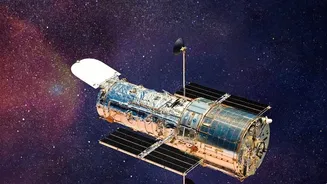
So how do scientists measure the temperature of something so impossibly distant? The key is to look beyond the visible light our eyes can see. Just as a hot piece of iron glows red, and an even hotter one glows white-hot, the temperature of an object determines the type of light it emits. The most energetic and hottest phenomena in the universe don't just glow in visible light; they blaze in high-energy X-rays. Telescopes like Chandra are designed specifically to detect this X-ray light. By analyzing the X-ray spectrum—the different 'colors' or energies of X-rays coming from a region—astronomers can calculate the temperature of the gas that emitted them. The presence of highly energetic X-rays is an unmistakable sign of extreme heat, often reaching temperatures of millions of degrees. It's like having a cosmic thermometer that can read the fevers of distant galaxies.
The Supermassive Engine
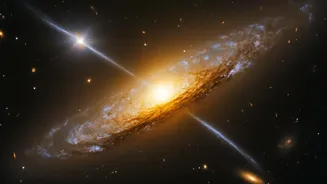
What could possibly generate this much heat across such vast stretches of space? In many cases, the culprit is the supermassive black hole lurking at the galaxy's center. These gravitational behemoths are not just passive sinkholes; they are cosmic engines. As gas and dust fall toward a black hole, they form a swirling accretion disk that heats up to incredible temperatures due to friction, blasting out intense radiation. Furthermore, many black holes fire powerful, focused jets of particles and energy out into the galaxy at nearly the speed of light. These jets and winds slam into the surrounding interstellar gas, creating massive shockwaves that heat the gas to millions of degrees, carving out huge cavities and bubbles. This process, known as 'feedback', is one of the most powerful forces shaping a galaxy.
How Heat Shapes a Galaxy's Future
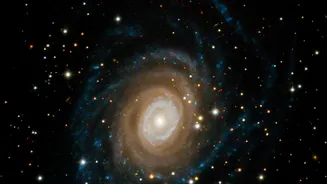
This intense heat is more than just a curiosity; it plays a crucial role in a galaxy’s life cycle. A galaxy's ability to form new stars depends on having a supply of cool gas that can collapse under gravity. But when a supermassive black hole's feedback mechanism heats this gas up, it becomes too energetic and diffuse to form stars. In effect, the central black hole can act as a thermostat for the entire galaxy, regulating or even shutting down star formation. By observing these hot regions, astronomers are not just seeing a spectacular cosmic phenomenon; they are watching a fundamental process of galactic evolution in action. The discovery of mature, hot gas clusters in the very early universe suggests this process started much earlier than models predicted, challenging our understanding of how these massive structures grew so quickly.