




The Crisis of Coral Bleaching
Coral reefs are vibrant ecosystems teeming with life, but they are incredibly sensitive. Their brilliant colours come from microscopic algae called zooxanthellae, which live in their tissues in a symbiotic relationship. The algae provide the coral with over
90% of its food through photosynthesis, while the coral provides a safe home. But when ocean temperatures rise even 1°C above the normal summer maximum for a few weeks, this partnership breaks down. The stressed coral expels the algae, losing its primary food source and its colour. This process, known as coral bleaching, leaves behind a ghostly white skeleton. While a bleached coral is not dead, it is severely weakened and vulnerable to starvation and disease. With climate change causing more frequent and intense marine heatwaves, mass bleaching events are happening more often, threatening reefs worldwide.
Nature's Hidden Champions: 'Super Corals'
In the wake of devastating bleaching events, scientists observed that some corals managed to survive, and even thrive, while their neighbours perished. These naturally resilient colonies, often dubbed 'super corals', have become a focal point of research. Their toughness isn't due to a single superpower. Some have evolved to tolerate higher temperatures. Others host hardier strains of symbiotic algae that don't become toxic under heat stress. Studies have shown that some resilient corals possess unique genetic advantages. For instance, researchers found that certain heat-resistant corals 'frontload' their stress-response genes, meaning they are already switched on and prepared for a heatwave before it even begins. This proactive defence mechanism gives them a crucial edge in a rapidly warming world.
From Lab to Lagoon: Restoring Our Reefs
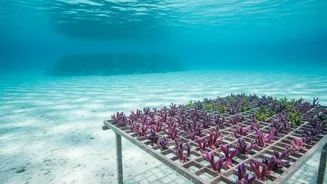
Harnessing the power of these super corals involves a multi-step restoration process. First, scientists identify and collect fragments from naturally resilient colonies. These fragments are then taken to underwater or land-based nurseries, where they are cultivated in ideal conditions. Techniques like 'microfragmentation', which involves breaking corals into small pieces, can accelerate growth by up to 50 times the natural rate, allowing scientists to grow large quantities of coral in months instead of decades. Once the corals are large enough, they are 'outplanted'—carefully attached back onto degraded reefs by trained divers. By focusing on these heat-tolerant genotypes, the goal is to build future reefs that have a better chance of surviving the next marine heatwave.
A Global Effort with Local Impact
This innovative work is happening across the globe, including right here in India. The nation's extensive coastline, with vital reef ecosystems in the Gulf of Mannar, Gulf of Kutch, Lakshadweep, and the Andaman and Nicobar Islands, makes this research critically important. For over two decades, Indian scientists have been leading one of the world's largest coral transplantation programmes in the Gulf of Mannar, refining techniques and achieving encouraging survival rates. In the Andamans, organisations are using mineral accretion technology, which uses low-voltage solar-powered currents to speed up coral growth. In Gujarat, the Mithapur Coral Recovery Project has successfully created artificial reefs and gardens, showcasing a model of community and corporate partnership in conservation.
Hope, Not a Silver Bullet
While assisted evolution and restoration offer a powerful new toolkit, they are not a magic solution. Scientists caution that this approach is complex and must be scaled up significantly to have a meaningful impact. Some restoration efforts have found a paradox: planting a single resilient species can boost growth but may reduce the fish biodiversity that a mixed-species reef supports. Furthermore, focusing too heavily on a few 'super' species could lead to monocultures that are vulnerable to other threats, like disease. Therefore, experts agree that these restoration efforts must be paired with aggressive global action to reduce greenhouse gas emissions. Helping corals adapt buys us precious time, but it cannot replace the urgent need to address the root cause of the problem: climate change.