




A Needle in a Cosmic Haystack
The simplest reason small asteroids are hard to find is their size. The solar system is vast, and these objects are tiny in comparison. While planetary defense programs have successfully catalogued over 90% of the truly enormous, civilisation-threatening
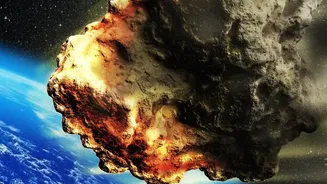
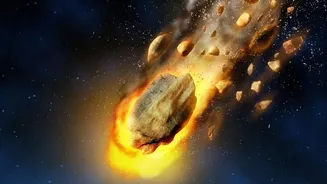
asteroids larger than a kilometre wide, the smaller ones are a different story. Objects in the range of a few dozen metres—like the one that exploded over Chelyabinsk, Russia, in 2013, injuring over 1,600 people—are far more numerous and reflect very little light. Spotting them is like trying to find a single piece of coal in a vast, dark field from hundreds of kilometres away. Our telescopes must be looking at the exact right patch of sky at the exact right moment to catch the faint glimmer of light they reflect.
Hiding in the Darkness
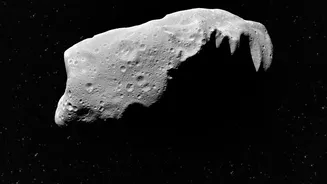
Compounding the size problem is their composition. Many asteroids are what scientists call 'low-albedo' objects, meaning they are incredibly dark. Some are as dark as charcoal or fresh asphalt, reflecting only a tiny fraction of the sunlight that hits them. This makes them incredibly faint targets for ground-based telescopes, which rely on detecting reflected visible light. An asteroid might look faint because it's very small and reflective, or because it's quite large but extremely dark. Distinguishing between the two requires more detailed observation, but first, you have to find the faint dot of light moving against the fixed background of stars.
The Sun's Blinding Glare
One of the biggest challenges in asteroid detection is the Sun. Ground-based telescopes are limited to observing the night sky. Any asteroid approaching Earth from the sunward direction is completely hidden in the Sun's glare. This was precisely the case with the Chelyabinsk meteor, which arrived undetected from the direction of the rising sun. This creates a significant blind spot in our planetary defence network. Asteroids with orbits that keep them mostly within Earth's own path around the Sun, known as Atira-class asteroids, are notoriously difficult to track for this reason. By the time they become visible in the night sky, they can be very close, leaving little time for observation or warning.
The Limits of Our Current Watch
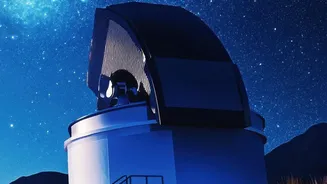
Current asteroid-hunting is a sophisticated, global effort. Surveys like the Catalina Sky Survey and Pan-STARRS systematically scan the sky every month, taking multiple images and using software to spot moving objects. When a potential new object is found, its details are sent to the Minor Planet Center, and other observatories around the world perform follow-up observations to confirm its path. This system is effective and has discovered thousands of near-Earth objects. However, it is fundamentally limited by telescope time, weather, the brightness of the moon, and the sheer scale of the sky that needs to be covered. We can only see what's visible from the night-side of Earth, and even then, it's a constant race against time to confirm an orbit before a faint object is lost again.
A Sharper Eye on the Sky
The good news is that our ability to watch the skies is about to take a massive leap forward. The Vera C. Rubin Observatory, which has already discovered thousands of new asteroids in its preliminary testing phases, will scan the entire southern sky every few nights with unprecedented depth and speed. It is expected to discover millions of new objects over its ten-year survey. Even more critical is the upcoming launch of NASA's NEO Surveyor space telescope, scheduled for no earlier than 2027. This infrared telescope will be placed in a stable orbit between the Earth and the Sun, allowing it to spot asteroids by the heat they radiate, rather than the visible light they reflect. This will allow it to find even the darkest asteroids and, crucially, to look into the Sun's glare, effectively eliminating our biggest blind spot.