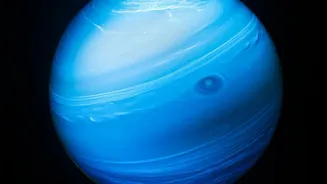

Meet the Newest Member of the Uranian Family
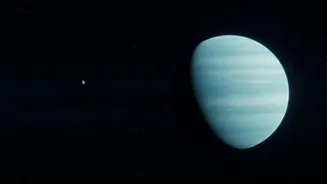
The newest moon to be officially recognized is provisionally named S/2023 U1. Discovered by a team led by Scott S. Sheppard of the Carnegie Institution for Science, this object is incredibly faint and small. With an estimated diameter of only about 8
kilometres, it is likely the smallest of Uranus’s known moons. It follows a long, distant, and eccentric orbit, taking roughly 680 Earth days to circle the ice giant. This discovery, the first new moon found around Uranus in over two decades, brings the planet’s total number of confirmed satellites to 28. Its confirmation relied on powerful ground-based telescopes like the Magellan telescopes in Chile, and required special image processing techniques to spot such a dim object against the blackness of space.
The Cosmic Detective Story: How It Was Found
Finding S/2023 U1 was a masterclass in cosmic detective work. Sheppard first spotted the moon on November 4, 2023. To confirm it was a moon and not just a passing asteroid, he and his collaborators at NASA's Jet Propulsion Laboratory had to determine its likely orbit. This allowed them to hunt for the object in older images. They successfully located it in data captured by the Magellan and Subaru telescopes as far back as 2021. This process of finding an object, predicting its path, and then verifying that path with previous observations is crucial for confirming new satellites. The ability to pull such a faint signal from years of data demonstrates a significant leap in our ability to survey the outer solar system.
Why This Tiny Discovery is a Big Deal
It’s natural to wonder why an 8-kilometre rock orbiting a planet nearly 3 billion kilometres away matters. The answer lies in its orbit. The distant and irregular path of S/2023 U1 strongly suggests it is a 'captured' object. Unlike Uranus's larger, circular-orbiting moons that likely formed from a disc of material around the planet, this small moon was probably a stray body that wandered too close and was snagged by Uranus's gravity billions of years ago. These captured moons are like cosmic fossils. They are relics from the solar system's chaotic youth, a time when planets were migrating and flinging smaller objects around like a gravitational slingshot.
A Window into a Violent Past
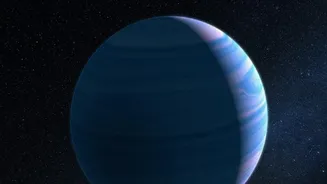
By studying the orbits of captured moons like S/2023 U1, scientists can piece together a history of the outer solar system. These moons are often found in groups, or families, with similar orbits, suggesting they might be fragments of a single, larger body that was captured and then shattered by Uranus's gravity. The new moon appears to have a similar orbit to two other Uranian moons, Caliban and Stephano, hinting that they may share a common origin. Understanding these orbital families helps model the gravitational forces and collisions that shaped the giant planets and their satellite systems into what we see today. Each new moon provides another critical data point for testing and refining these historical models. Recent studies of Neptune's moons using the James Webb Space Telescope (JWST) support this idea, suggesting some of its inner moons are wreckage from when its largest moon, Triton, was violently captured.
What Are Researchers Trying to Discover Next?
The discovery of S/2023 U1 is just the beginning. The next step for researchers is to refine its orbit with further observations. A precise orbit is key to confirming its place in the Uranian system and understanding its long-term stability. Scientists will also attempt to study its physical properties, like its color. The color of a space rock can provide clues about its composition and where in the solar system it originally formed. Furthermore, this discovery energises the case for a dedicated mission to the ice giant. The proposed Uranus Orbiter and Probe, a top priority for NASA, would be able to study these tiny, distant moons up close, moving them from faint points of light into fully realised worlds. Such a mission could finally reveal the secrets these captured relics have been holding onto for billions of years.