





Why We Need a New Approach
For years, discovering new antibiotics was a slow, expensive, and often fruitless process. Scientists would manually screen thousands of chemical compounds, hoping for a lucky break. This traditional method is too slow to keep pace with bacteria that
evolve resistance at an alarming rate. The result is a growing list of infections that are becoming difficult, and sometimes impossible, to treat. This challenge has pushed researchers to find a faster, cheaper, and more intelligent way to search for new drugs, leading them to the world of artificial intelligence.
Machine Learning: The Digital Sieve
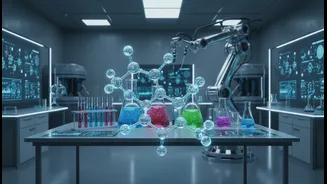
The first step is teaching a machine what an antibiotic looks like. Scientists feed a Machine Learning (ML) model vast amounts of data, showing it the chemical structures of thousands of molecules that are known to kill bacteria and thousands more that don't. The algorithm learns to identify the subtle patterns and properties that make a compound effective. Once trained, the AI acts like a super-powered digital sieve. It can then screen virtual libraries containing millions or even billions of potential chemical compounds in a matter of days—a task that would take humans a lifetime. The ML model flags a small number of the most promising candidates, known as 'hits', for further investigation.
Generative AI: Designing Drugs from Scratch
Beyond just finding existing compounds, some advanced AI models can design entirely new molecules. Using a technique called generative AI, researchers can tell the model what they're looking for—for instance, a compound that attacks a specific type of bacteria like MRSA. The AI then generates brand-new chemical structures that have never existed before but are predicted to have powerful antibacterial properties. This dramatically expands the search space for novel drugs, moving beyond what nature has created to what is computationally possible.
Chemical Optimisation: From Good to Great
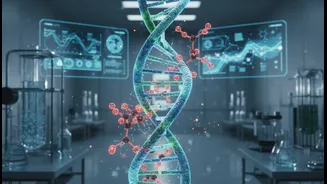
Finding a 'hit' is just the beginning. The initial compound might be effective, but it could also be slightly toxic to human cells or not stable enough to work in the body. This is where chemical optimisation comes in. This iterative process refines a promising compound to improve its drug-like qualities. AI can accelerate this step by predicting how small changes to the molecule's structure will affect its potency, selectivity, and safety. Instead of months of trial-and-error in the lab, chemists can use AI-driven suggestions to intelligently modify the compound, aiming to create a final drug candidate that is both powerful against bacteria and safe for patients.
Lab Assays: The Real-World Test
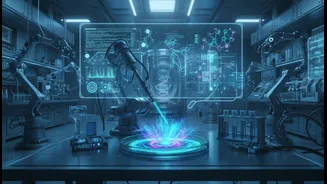
After all the digital work, the drug candidates must prove themselves in the real world. This happens through lab assays. An assay is a procedure to measure the biological activity of a substance. In this case, scientists take the compounds synthesized based on the AI's predictions and test them against live bacteria in a petri dish. They measure the 'zone of inhibition'—a clear ring where the antibiotic has killed the bacteria—to determine the compound's potency. This is the crucial step where the theoretical promise of an AI-designed drug meets the practical reality of biology. Compounds that perform well here may then move on to more extensive preclinical studies.