




A Trio of Worlds
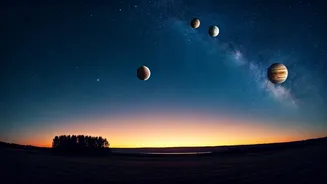
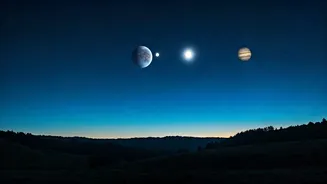
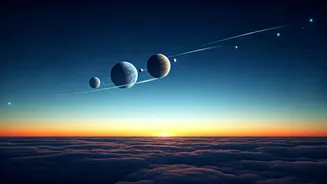
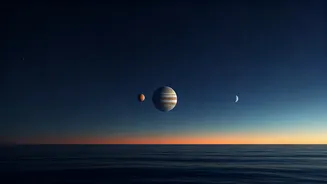
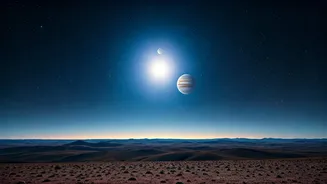
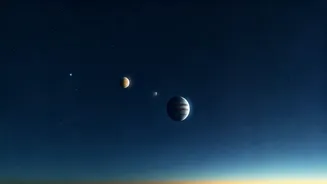
Over the next few evenings, you have the chance to witness a planetary conjunction, an event where multiple planets appear close to each other in our sky. This isn't a true physical alignment; the planets remain hundreds of millions of kilometres apart
in their own orbits. But from our vantage point on Earth, their paths seem to cross, creating a stunning visual spectacle. In this celestial meeting, you'll see the swift Mercury, the dazzling Venus, and the giant Jupiter gathered in a tight formation low on the western horizon. It’s a perfect opportunity for city dwellers and seasoned astronomers alike to connect with the cosmos.
When and Where to Look
The key to catching this alignment is timing. The best window for viewing is approximately 30 to 75 minutes after sunset. As the sun dips below the horizon, the sky will darken enough for the planets to become visible, but they will still be high enough to be seen before they, too, set. You need to look towards the west, in the same direction the sun just went down. The planets will be low, so an unobstructed view of the horizon is essential. Rooftops, balconies facing west, or open parks away from tall buildings and dense trees are your best bets. The phenomenon will be visible across India, from Delhi to Chennai.
Identifying the Planets
You don't need to be an expert to tell the planets apart. Your primary guide will be Venus. It will be unmistakably brilliant, shining as the brightest object in the post-sunset sky, often called the 'Evening Star'. It will outshine any actual star. Jupiter will be the second brightest of the trio, appearing as a steady, bright point of light. The real challenge, and the prize of the hunt, is Mercury. As the innermost planet, it never strays far from the sun's glare. It will be the faintest of the three and closest to the horizon. Look for it just below and to the side of the much brighter Venus. Think of Venus as your signpost to find the other two.
Do You Need a Telescope?
Good news: you don't need any special equipment to enjoy the main show. The bright duo of Venus and Jupiter will be easily visible to the naked eye. In fact, their combined glow will likely be what first catches your attention. However, if you have a pair of binoculars, this is the perfect time to use them. Binoculars will dramatically improve your view, making Jupiter appear as a distinct disc rather than a point of light. Most importantly, they will be your best tool for spotting the elusive Mercury, which can be easily lost in the twilight haze. A telescope would, of course, reveal even more detail, like Jupiter's moons, but it is by no means necessary for appreciating the alignment itself.
A Cosmic Coincidence
So, what causes this celestial meeting? It all comes down to orbital mechanics and perspective. All the planets in our solar system, including Earth, orbit the Sun on roughly the same plane, like cars on a multi-lane racetrack. But they all move at different speeds. Mercury completes its lap in just 88 Earth days, while Jupiter takes nearly 12 years. A planetary conjunction occurs when Earth's position, along with the positions of two or more other planets, creates a line of sight that makes them appear clustered in the sky. These events are a beautiful, predictable result of the clockwork motion of our solar system, a reminder of the grand, silent dance happening above our heads every single night.