





The First Commandment: Label Everything
The single most important rule of any shared kitchen is to label your food. This simple act prevents accidental theft and reduces the guesswork during the inevitable clean-out. A roll of masking tape and a permanent marker are your best friends. Clearly
write your name and the date you placed the item in the fridge. This isn’t just about ownership; it’s a courtesy that helps everyone know what’s fresh and what’s been slowly evolving into a new life form in the back. For items you're willing to share, like a carton of milk or a bottle of ketchup, label it “Communal” to avoid any confusion.
Decoding the Dates: 'Use By' vs. 'Best Before'
Understanding food labels is crucial for both safety and reducing waste. The two most common labels, 'Use By' and 'Best Before', mean very different things. The 'Use By' date is about safety. It is typically found on perishable items like meat, fish, and dairy products. You should not consume these foods after the 'Use By' date, even if they look and smell fine, as they could contain harmful bacteria. The 'Best Before' date, however, is about quality. This date indicates when the product will be at its peak flavour and texture. Items like canned goods, biscuits, and pasta are often perfectly safe to eat long after this date has passed, though they might not be as crisp or flavourful.
Shelf Strategy: Create Zones of Order
A chaotic fridge where items are stuffed in any available gap is a recipe for disaster. Establishing a clear system for shelf space is key. One effective strategy is to assign a specific shelf or a section of a shelf to each person. This creates personal responsibility and makes it easy to find your things. If assigning shelves feels too rigid, agree on general zones. For example, the door shelves can be for shared condiments, one drawer for vegetables, and the main shelves for individual meals and containers. Crucially, don't take up more space than you need; a shared fridge is not the place to store your entire week's grocery haul. Bring in lunches daily if possible to keep space at a premium.
The Forbidden List: What Not to Store
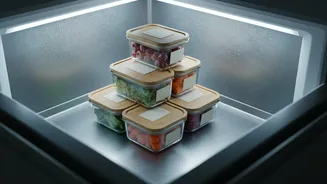
Common courtesy extends to what you choose to introduce into a shared space. Extremely pungent foods, like strong cheeses or fish, should be stored in truly airtight containers. No one wants to be hit with an overwhelming odour every time they open the door. Leaky containers are another major offence. Ensure your dabbas and takeaway boxes are sealed properly to prevent spills that someone else will have to clean up. Better yet, make it a rule to clean up your own spills immediately. A simple wipe-down takes seconds and maintains a hygienic environment for everyone.
The Weekly Purge: A Necessary Ritual
Even with perfect labelling, fridges need a regular reset. Designate a specific time each week, perhaps Friday afternoon, for a fridge clean-out. This is when everyone should take a moment to remove their old food, empty containers, and anything past its prime. For abandoned, unlabelled mysteries, a 'one warning' policy works well. A note can be sent around or placed on the fridge stating that all unclaimed items will be discarded by a certain time. This avoids turning one person into the reluctant 'Police Chief of the Refrigerator' who has to conduct sniff tests on suspicious packages.
Conflict Resolution: No More Sarcastic Notes
Passive-aggressive notes are a hallmark of a dysfunctional fridge environment. While they might provide a moment of catharsis for the writer, they rarely solve the underlying issue and often just create resentment. If a fridge-related problem arises—someone consistently eats your yoghurt or leaves messes—the best approach is direct and polite communication. A quiet, face-to-face conversation is far more effective than a public shaming note. Frame the discussion around establishing clear group rules that everyone can agree on, rather than singling out an individual. Often, a simple chat is all it takes to resolve an issue before it escalates.