


A Discovery Buried in the Shadows
While the Chandrayaan-3 lander captured the world's attention with its historic touchdown, its predecessor's orbiter has continued to be a silent workhorse in lunar orbit. The Chandrayaan-2 orbiter, circling the Moon since 2019, is equipped with a sophisticated
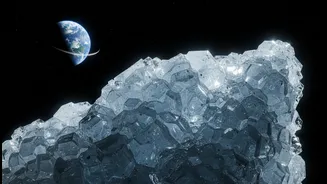
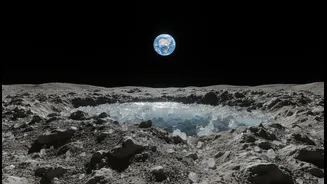
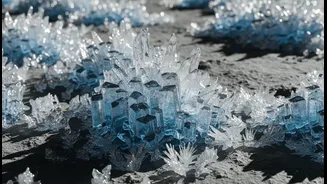
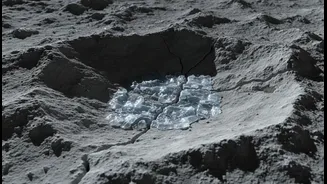
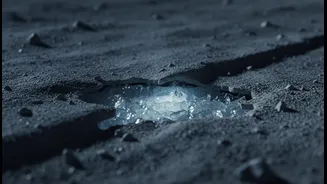
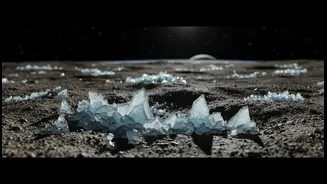
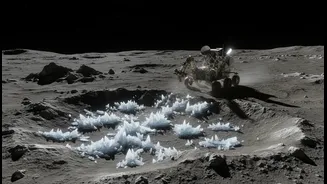
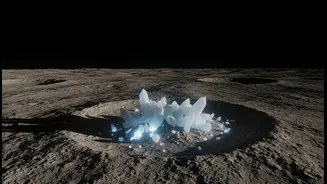
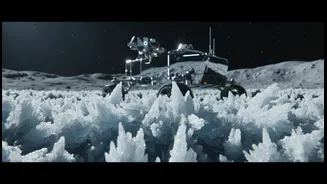
suite of instruments, including the Dual-Frequency Synthetic Aperture Radar (DFSAR) and the Imaging Infrared Spectrometer (IIRS). Recent data, particularly from its advanced radar scans, has provided some of the strongest evidence yet of significant water ice deposits hidden beneath the surface in the Moon's south polar region. These are not just hints of surface frost, but clues pointing to substantial reserves buried in permanently shadowed regions—craters that haven't seen direct sunlight in billions of years. This confirmation is crucial; it moves the presence of lunar water from theory to a tangible asset, providing high-resolution maps that future missions can rely on.
Why Water Ice Is the Moon’s New Gold
On Earth, water is essential for life. In space, it's that and much more. The concept of 'in-situ resource utilization' (ISRU) is central to making long-term space exploration sustainable, and water is the key ingredient. Firstly, it can be purified for drinking and growing plants, and its oxygen component can be extracted to provide breathable air for astronauts in a future lunar habitat. But the real game-changer is its potential as rocket fuel. By splitting water molecules (H2O) into hydrogen and oxygen through electrolysis powered by solar arrays, the Moon could become a cosmic refueling station. Launching heavy payloads of water and fuel from Earth is prohibitively expensive due to our planet's strong gravity. Producing propellant on the Moon would drastically cut the cost and complexity of missions to Mars and beyond, turning our celestial neighbour into a vital staging post for humanity's expansion into the solar system.
The Global Debate: Setting Rules for Space
The confirmation of valuable resources inevitably leads to a crucial question: who owns them? The 1967 Outer Space Treaty forbids any nation from claiming sovereignty over a celestial body like the Moon. However, it is less clear on the issue of resource extraction. To address this, the United States initiated the Artemis Accords, a set of non-binding principles to guide the civil exploration and use of outer space. India became a signatory in June 2023, joining a growing list of nations committed to transparent and cooperative space activities. A central tenet of the Accords is that the extraction of space resources is permissible and does not constitute national appropriation. These accords are an attempt to create a framework for a future lunar economy, ensuring that activities are conducted safely and without conflict, but they are not without geopolitical rivals, such as the competing China-Russia International Lunar Research Station (ILRS) project.
How Ice Gives India a Seat at the Head Table
By signing the Artemis Accords, India secured its place in the global conversation. But with the data from Chandrayaan-2, its role is elevated from that of a participant to a pivotal stakeholder. Scientific data is geopolitical currency in the 21st century. The high-resolution maps of potential water ice and mineral deposits being generated by ISRO's orbiter are not just academic curiosities; they are foundational to the entire enterprise of lunar resource utilization. Nations and private companies looking to invest billions in lunar missions need to know where to go, and ISRO is providing one of the most detailed roadmaps. This gives India significant leverage. Its voice in discussions about resource management, revenue sharing, and the legal frameworks governing the lunar economy becomes more influential. It’s one thing to agree to a set of rules; it’s another to provide the essential data that makes those rules actionable. ISRO’s scientific prowess is translating directly into strategic strength.