


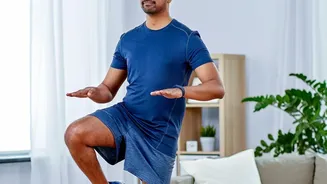

The Foundation: Perfect Your Form
Before you start adding flair, focus on the fundamentals to get the most out of every step. Stand tall with your shoulders relaxed and back. Engage your core to support your posture. Begin marching on the spot, lifting your knees as if you're walking
with purpose. Land softly on the balls of your feet and roll through to your heels. Don't forget your arms; let them swing naturally as they would during an outdoor walk. Pumping your arms more vigorously can increase your heart rate and calorie burn.
Level Up: Add Arm Variations
Once you're comfortable with the basic march, incorporating your upper body is the easiest way to boost intensity. While walking in place, try adding different arm movements. You can do bicep curls, overhead shoulder presses, or triceps kickbacks. Even simple arm swings, like reaching up to the ceiling and then pulling down, or punching forward with alternating arms, will engage more muscles, elevate your heart rate, and turn a simple walk into a full-body exercise.
Introduce Leg Variations
Your legs can do more than just march up and down. To challenge different muscles and keep things interesting, mix in other movements. Try high knees, bringing your knees up toward your chest to engage your lower abs. Then, switch to butt kicks, trying to touch your heels to your glutes to work your hamstrings. Side steps or 'grapevines' are great for lateral movement and working your inner and outer thighs. Alternating between these every 30 to 60 seconds creates a dynamic, engaging routine.
Play With Pace and Intensity
One of the most effective training tools is interval training, and you can easily apply it to walking in place. Alternate between a moderate, steady pace for a few minutes and short bursts of high-intensity effort. For 30 to 60 seconds, march as fast as you can, lifting your knees high and pumping your arms hard. Then, return to a slower, recovery pace for one to two minutes. This method, known as High-Intensity Interval Training (HIIT), is highly effective at burning calories and improving cardiovascular health in a short amount of time.
Incorporate Light Resistance
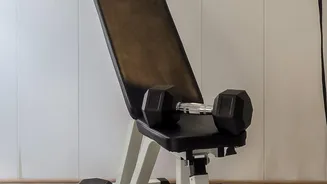
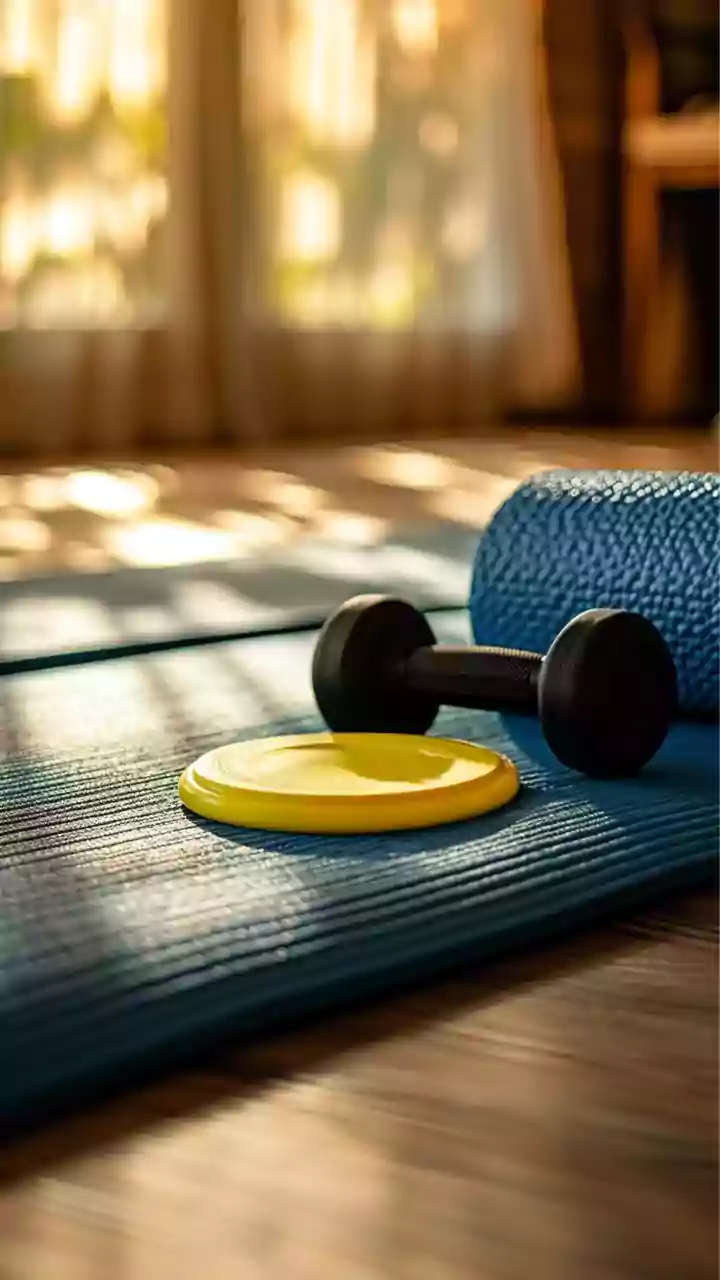
If you have them, light hand weights or wrist weights can add a significant challenge to your arm movements. As you perform bicep curls or shoulder presses, the added weight increases resistance, helping to tone and strengthen your upper body. Ankle weights can be used to add resistance to your leg lifts. If you want to increase the overall calorie burn, a weighted vest makes your body work harder with every step you take. Start with a light weight and gradually increase it as you get stronger.
Create a Mini -Circuit
Combine these ideas into a structured workout. You don't need a complicated plan. Try a simple circuit format. For example : begin with a 3 -minute warm -up of basic walking in place . Then , perform each variation for 60 seconds : high knees , butt kicks with bicep curls , side steps , and a fast -paced march . After completing all four moves , rest for a minute or return to a slow walk . Repeat the entire circuit two or three times for a complete 10 -to -15 -minute workout that will leave you feeling energised and accomplished .