




The Universe’s Coolest Experiment
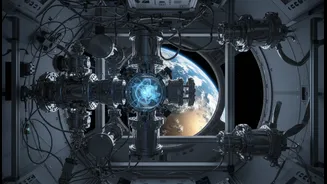
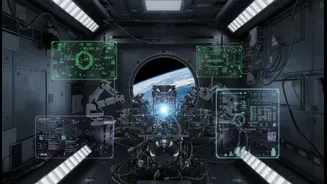
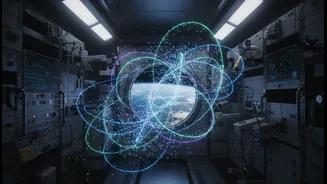
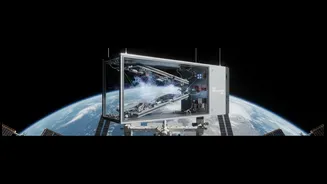
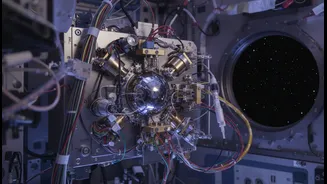
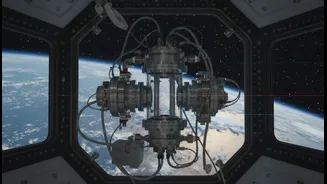
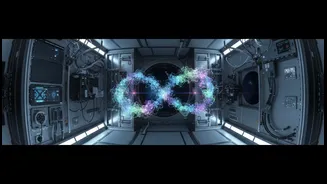
Since its installation in 2018, the Cold Atom Lab (CAL) has been a quantum physics powerhouse in orbit. Its primary job is to cool atoms like rubidium and potassium to temperatures just a fraction above absolute zero—the point where all atomic motion
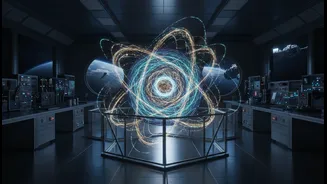
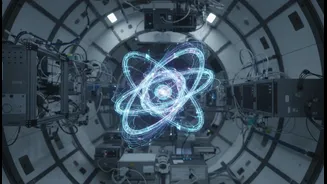
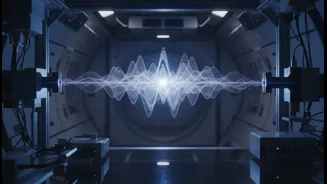
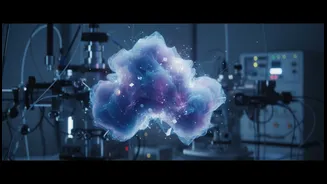
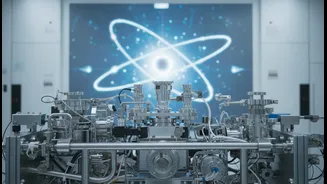
is supposed to stop. Using lasers and magnetic traps, CAL chills atoms to create a bizarre state of matter called a Bose-Einstein Condensate (BEC). In a BEC, thousands of individual atoms lose their identity and behave as one single, massive quantum wave. This allows scientists to observe quantum phenomena, which are usually confined to the subatomic realm, on a macroscopic scale. Performing these experiments in the microgravity of the ISS is a game-changer. On Earth, gravity quickly pulls these delicate condensates apart. In space, they can be observed for much longer, allowing them to cool even further and expand, revealing properties impossible to study on the ground.
From Quantum Oddities to Cosmic Unknowns
For years, the focus was on understanding the nature of these ultra-cold atoms and their strange behaviours, like forming quantum bubbles that would be impossible on Earth. This work has been crucial for developing what some call 'quantum 2.0'—the direct manipulation of large quantum states. However, armed with several hardware upgrades, the most recent of which arrived in April 2026, CAL's mission is expanding. Scientists are now using this incredible sensitivity to probe some of the biggest questions in physics. The new objectives go far beyond just creating BECs; they aim to test Einstein's theory of general relativity with unprecedented precision and even search for clues about the nature of dark matter and dark energy, the mysterious substances believed to make up most of our universe.
New Tools for Probing Reality
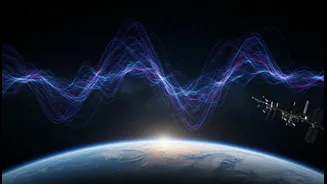
Recent upgrades have significantly enhanced CAL’s capabilities. A redesigned magnetic trap now allows scientists to actively shape the quantum gas clouds, squeezing them into lines or flattening them into pancakes, which helps in investigating new properties. This level of control is essential for a technique called atom interferometry. Think of it like splitting a water wave and watching how the ripples interfere when they recombine. Scientists can split a BEC's matter wave in two and recombine it. Because the wave is exquisitely sensitive to its environment, any tiny variation in gravity will change the resulting interference pattern. This turns the CAL into an incredibly precise sensor, capable of detecting the most subtle gravitational shifts. It's a tool so sensitive that it might one day detect the faint gravitational tug of passing dark matter particles.
The Future of Quantum Technology
The research isn't just about answering abstract cosmic questions. The foundational science being done on the Cold Atom Lab serves as a crucial proving ground for the next generation of quantum technologies. The extreme precision of atom interferometers could lead to revolutionary navigation systems for deep space exploration. Future spacecraft could navigate by sensing tiny variations in gravity, acting as a sort of 'quantum compass' without needing to constantly communicate with Earth for GPS-like positioning. On Earth, similar technologies could lead to new ways of monitoring climate change by tracking water and ice movement through their gravitational signatures. It could also lead to better atomic clocks, which are vital for GPS and global timekeeping. By demonstrating that these complex quantum experiments can be reliably operated in space, CAL is paving the way for a future where quantum technology is a standard tool for both science and exploration.