








A Landmark Discovery from the Himalayas
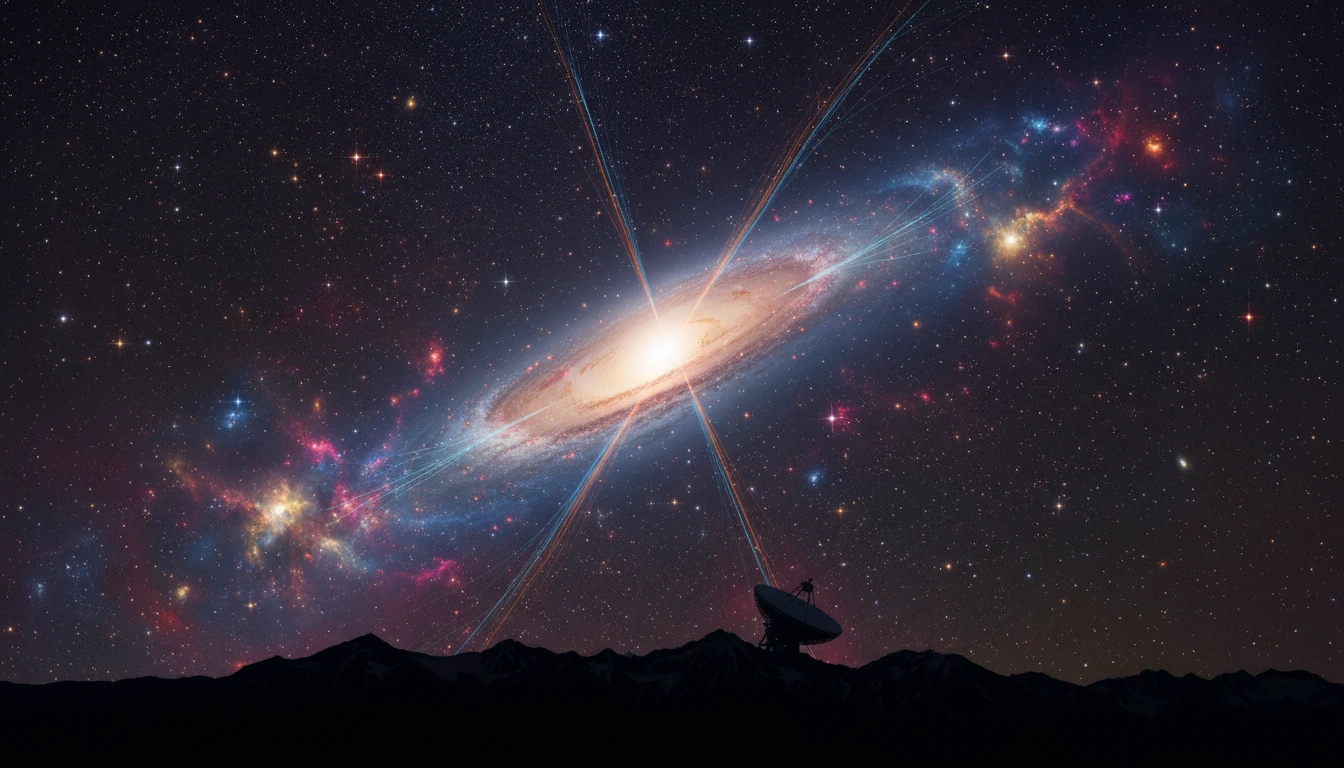
In a remote village in Sikkim, student Pranim Limboo was doing something extraordinary: analysing complex radio astronomy data on his computer. As a volunteer for a citizen science project, he was trained to spot unusual shapes in images from powerful
telescopes. He flagged a galaxy that looked different from anything seen before, shaped like a bow and arrow. This wasn't just a fleeting observation. After verification by professional astronomers, Limboo's finding was confirmed as a unique type of radio galaxy, now named BAARG (Bow-and-Arrow-shaped Radio Galaxy). The discovery, made by a student from his home, was significant enough to be published in the prestigious 'Monthly Notices of the Royal Astronomical Society'.
The Engine: The RAD@home Collaboratory
Pranim Limboo's journey from curious student to co-author on a scientific paper was made possible by RAD@home, an Indian citizen science network. The project's mission is to prove that anyone with a passion for science can contribute to high-level research. It trains volunteers—from undergraduates to teachers and the general public—to analyse vast datasets generated by telescopes like the Giant Metrewave Radio Telescope (GMRT) near Pune. Through online classes and collaborative platforms, participants learn to identify features in radio images of distant galaxies. This 'training and collaboration' is the core of the model, turning public enthusiasm into a powerful, distributed research workforce. The programme effectively tackles astronomy's big data problem by transforming it into a developmental opportunity for the nation.
Human Eyes versus Smart Algorithms
In an age of artificial intelligence, it might seem counterintuitive to rely on human volunteers to sift through data. However, the discovery of the bow-and-arrow galaxy highlights a crucial truth: humans are exceptionally good at pattern recognition. Automated machine-learning systems had previously scanned the same data and catalogued the object as a standard radio galaxy, missing its strange shape entirely. It took the fresh perspective of a trained human eye to notice the anomaly. Citizen science projects like RAD@home leverage this unique human ability at a massive scale. Volunteers are not just labelling data; they are making discoveries by spotting morphological oddities that algorithms, designed to find what they expect, often overlook.
Democratising Science Across India
The story of Sikkim's citizen astronomer is not an isolated event but part of a growing movement across India. Citizen science is breaking down the walls of academic silos and making research more accessible and democratic. Projects range from mapping biodiversity and tracking the impact of climate change to discovering asteroids through initiatives like the All India Asteroid Search Campaign (AIASC). These programmes foster a scientific temper, as mandated by the Indian Constitution, and empower people from all walks of life to participate in the nation's scientific journey. By involving local communities, they generate valuable, hyperlocal data that would otherwise be difficult or expensive to collect, contributing directly to conservation and policy-making.