








The Final Frontier's Junkyard Problem
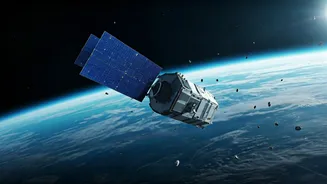
The romantic image of space often omits its messy secret: our orbit is cluttered. For over 60 years, we have been launching objects into space with little thought for their eventual fate. The result is a cloud of ‘space junk’—defunct satellites, spent
rocket stages, and fragments from collisions—whizzing around Earth at terrifying speeds. The U.S. Space Surveillance Network tracks over 27,000 pieces of orbital debris larger than a softball, with estimates of smaller, untrackable pieces numbering in the millions. This debris poses a significant threat to active satellites that provide us with everything from GPS navigation and weather forecasting to internet connectivity. A single collision could trigger a catastrophic chain reaction, a scenario known as the Kessler syndrome, rendering certain orbits unusable for centuries. This, combined with the environmental impact of traditional rocket propellants, has forced the industry to a critical turning point.
The Reusability Revolution
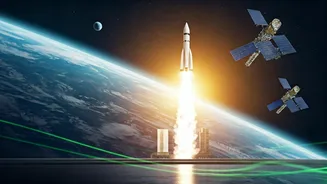
The most visible sign of this shift is the reusable rocket. Pioneered and perfected by companies like SpaceX with its Falcon 9, the concept has fundamentally altered the economics and environmental calculus of spaceflight. Instead of discarding multi-million dollar rocket boosters into the ocean after a single use, they can now return to Earth, land autonomously, and be refurbished for future missions. This isn't just a cost-saving measure; it's a massive leap in sustainability. Reusability dramatically reduces the manufacturing footprint and waste associated with building new rockets for every launch. What was once science fiction is now routine, and it has set a new standard. Competitors across the globe, from Blue Origin to emerging players in Europe and Asia, are now racing to develop their own reusable launch systems, cementing it as a foundational principle of modern space access.
Cleaner Fuel for the Cosmos
Beneath the gleaming exterior of a rocket lies a complex chemical engine, and for a long time, the fuels of choice were highly effective but also highly toxic. Hydrazine and its derivatives, known as hypergolic propellants, are carcinogenic, corrosive, and incredibly harmful to the environment if spilled. Handling them requires extensive and costly safety measures. Today, a new generation of launch providers is championing ‘green’ propellants. These alternatives, often based on refined kerosene (RP-1) and liquid oxygen, or newer formulations like methane, are not only cheaper and denser but also significantly less toxic. This makes them safer to handle on the ground and reduces the environmental fallout from launches. Companies like Relativity Space and ULA (with its new Vulcan Centaur rocket) are betting big on methane, signaling a crucial industry-wide move away from the hazardous fuels of the Cold War era.
Satellites Designed to Disappear
Preventing the creation of new junk is just as important as cleaning up the old. For years, satellites were simply abandoned in orbit at the end of their lifespan. The new industry ethos is ‘design for demise.’ Modern satellite manufacturers are now incorporating end-of-life plans directly into their designs. This can mean including enough extra fuel for a de-orbit burn, where the satellite pushes itself back into Earth’s atmosphere to burn up harmlessly. For satellites in higher orbits, the standard is to move them into a designated ‘graveyard orbit,’ safely out of the way of operational spacecraft. Furthermore, companies are experimenting with novel technologies like drag sails, which deploy at the end of a mission to increase the satellite’s atmospheric drag, causing its orbit to decay much faster than it would naturally.
The Orbital Cleanup Crew
While preventing new debris is key, what about the millions of pieces already up there? This has sparked one of the most exciting new sectors in the space economy: active debris removal (ADR). Think of it as cosmic sanitation. The European Space Agency is spearheading a mission called ClearSpace-1, planned for launch in 2026, which will use a four-armed robotic craft to capture and de-orbit a piece of a discarded rocket. In Japan, the company Astroscale has already demonstrated its ability to magnetically dock with and manoeuvre a target satellite. These missions are complex and expensive, but they are crucial proofs-of-concept for a future where we can actively manage and clean our orbital environment, much like we manage shipping lanes or airspace.