




The Sun’s Hidden Temper
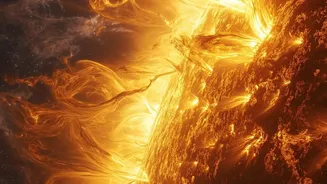
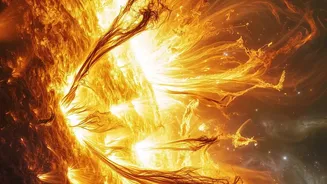
The Sun, our life-giving star, has a volatile side. It periodically releases enormous bursts of energy and matter in events known as solar storms. The most significant of these are Coronal Mass Ejections (CMEs), which are gigantic bubbles of magnetised
plasma and particles hurled into space at speeds that can exceed millions of miles per hour. While many CMEs miss our planet, those directed at Earth can have profound consequences. Think of a CME not as a gentle wave, but as a colossal cannonball of charged particles. When this barrage interacts with Earth's magnetic field, it triggers a geomagnetic storm, which can wreak havoc on the technological systems that form the backbone of modern society. Forecasters monitor the Sun constantly, watching for the tell-tale signs of these eruptions, such as solar flares, which are intense flashes of radiation that often precede a CME.
A High-Tech World's Vulnerability
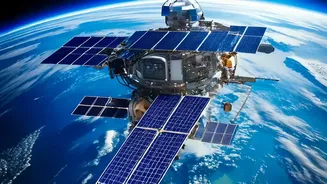
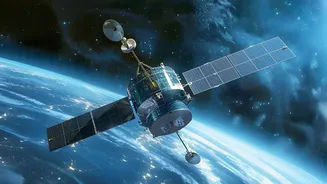
Our dependence on technology makes us uniquely susceptible to solar storms. Satellites are on the front line; the energetic particles from a storm can fry their sensitive electronics, while the heating of the upper atmosphere increases drag, causing satellites in low-Earth orbit to lose altitude and potentially burn up. Down on the ground, the danger is just as real. A powerful geomagnetic storm can induce immense electrical currents in long conductors like power lines. These geomagnetically induced currents can overload transformers, leading to widespread and long-lasting blackouts. The historical precedent is the Carrington Event of 1859, the most intense geomagnetic storm on record. It caused telegraph systems worldwide to fail, with some operators receiving electric shocks and pylons throwing sparks. If a storm of that magnitude occurred today, the disruption to power grids, GPS, and communication networks would be catastrophic, with potential economic damages in the trillions.
Our Eyes on the Sun
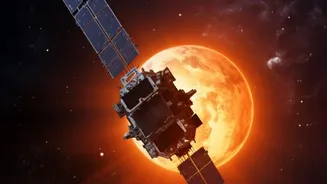
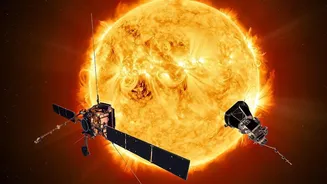
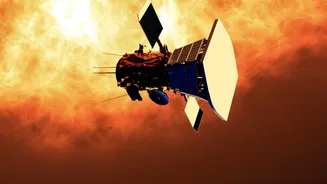
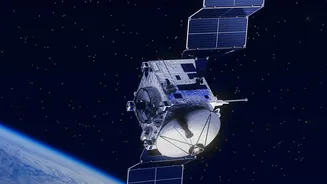
To protect against this threat, a global network of sentinels keeps a vigilant watch on the Sun. At the heart of this effort is the Space Weather Prediction Center (SWPC), part of the U.S. National Oceanic and Atmospheric Administration (NOAA). The SWPC is the official source for space weather alerts and warnings in the United States, operating 24/7. Its forecasters rely on data from a suite of satellites and ground-based observatories. A key asset is the Deep Space Climate Observatory (DSCOVR) satellite, positioned at a special point in space about 1.5 million kilometres from Earth. This location allows it to monitor the solar wind—the stream of charged particles constantly flowing from the Sun—and detect the approach of a CME, giving crucial lead time before it reaches our planet. Other satellites, like those in the GOES series, provide continuous imagery of the Sun itself, helping to spot eruptions as they happen.
From Prediction to Protection
When a potentially hazardous CME is detected, the monitoring networks spring into action. The SWPC issues watches, warnings, and alerts, much like the National Weather Service does for terrestrial storms. These alerts are sent to critical infrastructure operators, including power grid companies, satellite operators, airlines, and navigation services. With this advance notice, which can range from minutes to days depending on the storm's speed, operators can take protective measures. Power companies can prepare to adjust grid loads and take vulnerable transformers offline to prevent catastrophic damage. Satellite operators can place their spacecraft into a protective 'safe mode' to shield sensitive electronics. Airlines may reroute flights to avoid polar regions, where the effects of space weather and radiation are strongest. This ability to move from prediction to action is what safeguards our systems from the worst impacts.
The Future of Space Weather Forecasting
The science of space weather forecasting is constantly evolving. In June 2026, NOAA's SOLAR-1 observatory officially entered service, becoming the first U.S. satellite designed exclusively for operational space weather observations. It provides higher-quality data and delivers it faster, reducing the time to get imagery of a CME from up to eight hours to just 30 minutes. Looking further ahead, researchers are developing new techniques using artificial intelligence and machine learning to improve the accuracy and lead time of forecasts. Other planned missions, like the ESA's HENON CubeSat mission set for 2027, will venture even farther from Earth to sample the solar wind earlier, potentially increasing warning times from 15 minutes to several hours for the fastest storms. These advancements are crucial as we become ever more reliant on space-based technology.