





A World of Rust and Riddles
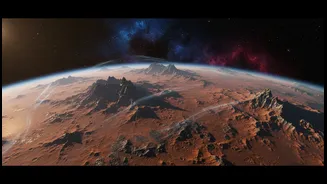
Mars is often called the Red Planet, but a closer look reveals a world of many colors: butterscotch, gold, and tan. Its famous reddish hue comes from iron minerals in the Martian soil that have rusted over billions of years. This fine, rusty dust gets
kicked up into the thin atmosphere, giving the entire planet its signature pinkish-red appearance from afar. For decades, scientists have sent orbiters, landers, and rovers to this alluring world, driven by one of the biggest questions in science: was Mars ever home to life? The key to answering that question has always been to “follow the water,” and the trail has led to a fascinating and salty conclusion.
Uncovering the Salty Truth
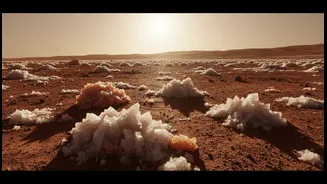
Across the Martian surface, from the vast southern highlands to the floor of ancient craters, scientists have found widespread deposits of salts. These are not quite like table salt. Instead, they are often chlorides and perchlorates, chemical compounds that have dramatic effects on their environment. Missions like NASA’s Mars Odyssey orbiter, and rovers like Curiosity and Perseverance, have used sophisticated instruments to detect these minerals. The data revealed that these salts are relics of a bygone era, likely formed between 3.5 and 3.9 billion years ago when Mars was transitioning from a potentially warmer, wetter world to the cold desert we see today. They are, in essence, the mineral ghosts of evaporated water.
Why Salt Changes Everything
The discovery of these specific salts, particularly perchlorates, is the planet’s biggest secret. On Earth, we put salt on roads in winter because it lowers the freezing point of water. On Mars, perchlorates do the same thing, but far more effectively. Mars has an extremely thin atmosphere and is brutally cold, meaning pure liquid water can't last on the surface; it either freezes or boils away. However, water mixed with perchlorate salts—a brine—can remain liquid at much lower temperatures. These salts are also hygroscopic, meaning they can absorb water vapor directly from the thin Martian atmosphere. This raises the tantalizing possibility that thin films of salty, liquid water might still form on Mars today, especially at night or during the winter.
A Sign of Ancient Oceans?
While the salts provide a mechanism for potential liquid water today, they are also a powerful window into the past. Many of these chloride deposits are found in basins and low-lying areas, exactly where you would expect water to pool and evaporate over long periods. Scientists believe these are not necessarily the beds of vast, global oceans, but rather evidence of groundwater seeping to the surface or regional lakes that existed for extended periods. As this water evaporated, it left behind the concentrated salt deposits we see today, like a bathtub ring on a planetary scale. These findings, especially those from rovers like Perseverance in Jezero Crater, strongly support the idea of a Mars that once had a much more active water cycle, with rivers feeding into crater lakes.
The Hunt for Martian Life
So, what does this salty secret mean for the search for life? The implications are complex. On one hand, the existence of enduring bodies of water in Mars's past makes it a more promising place to look for signs of ancient microbial life. Salt is excellent at preserving organic material, and some organisms on Earth thrive in extremely salty environments. NASA's rovers have already detected complex organic molecules—the building blocks of life—in areas with these salt and mineral deposits. On the other hand, the brines that might exist on Mars today would be extremely cold and salty, a very harsh environment for life as we know it. Still, the discovery of these salts directs scientists to the most promising locations to search for biosignatures, turning these ancient, salty lakebeds into prime targets for future exploration.