




An Unassuming Treasure
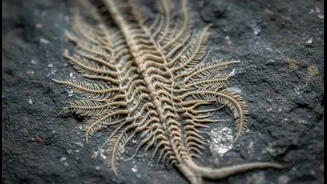
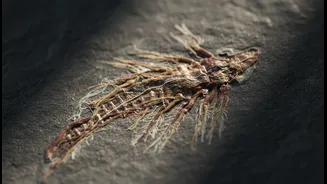
The story begins not with a dramatic dig in a remote desert, but in the quiet archives of a small museum in Montréal. Paleontologists from the University of Oklahoma were examining a specimen of a 450-million-year-old creature called Dendrocrinus simcoensis.
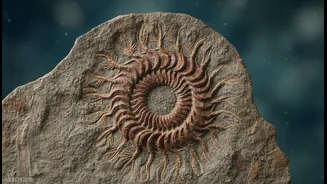
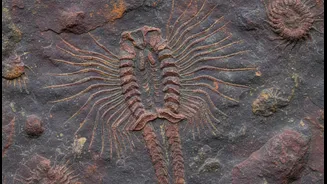
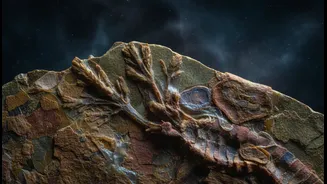
This animal, a crinoid, was a distant relative of modern starfish and sea urchins, resembling a flower anchored to the seabed. While millions of crinoid fossils exist, this one held a secret. Preserved within the rock were the faint, pyritized remains of its soft tissues—specifically, its tube feet. It is only the second time such soft tissues have ever been found in a crinoid, and this specimen is by far the oldest, making it an extraordinarily rare find.
A Glimpse into an Alien Ocean
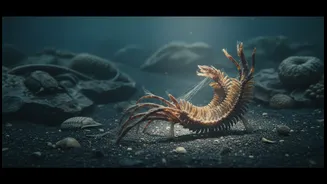
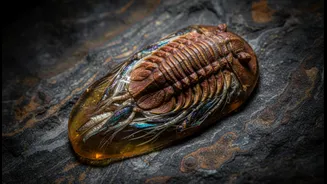
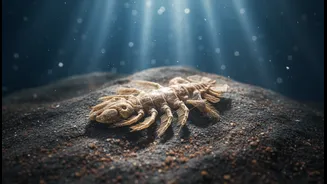
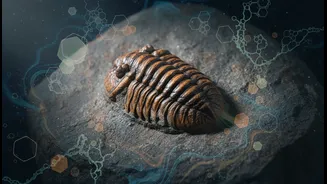
To understand the importance of this fossil, we must travel back 450 million years to the Ordovician Period. At this time, life on land was still in its infancy, but the oceans were teeming with complex animal communities. In these ancient seas, creatures like Dendrocrinus thrived in some of the planet’s earliest reef ecosystems. They were not alone. The waters were home to giant sea scorpions, some growing to the size of a person, which hunted armored, bug-like trilobites on the seafloor. It was a world both familiar in its ecological complexity and alien in its cast of characters. The Dendrocrinus fossil provides a vital, high-fidelity snapshot of one of the key players in this ancient marine drama.
Rewriting the Rules of Reconstruction
Most fossils preserve only hard parts like bones, teeth, or shells. Soft tissues like skin, organs, and muscles are the first to decay and are almost never saved. Their preservation requires incredibly specific and rare conditions—a natural version of a vacuum-seal, protecting the organism from decay and scavengers. Because of this, paleontologists have to make educated guesses about how an ancient animal lived, based on its skeleton and comparisons to modern relatives. The discovery of preserved tube feet in Dendrocrinus changes the game. It’s like finding the engine of a long-lost car instead of just its chassis. Scientists can now directly study the anatomy used for feeding and moving, rather than just inferring it. This provides concrete evidence that allows them to make far more accurate reconstructions of the animal's life.
From Fossil to Living Creature
The process of bringing an extinct animal back to life on paper or screen is a careful blend of science and art. It involves detailed analysis of the fossil's functional morphology—how the shape of its bones relates to its movement and behavior. This discovery makes that process profoundly more accurate. By comparing the ancient tube feet to those of modern crinoids, researchers found that the anatomy was surprisingly different. This suggests the 450-million-year-old species fed and behaved in ways that have no direct modern equivalent, occupying a unique ecological role. The find challenges previous assumptions and forces a re-evaluation of how these early animals lived, demonstrating how a single, exceptional fossil can reshape our understanding of an entire evolutionary branch.
Why the Deep Past Matters Now
While a 450-million-year-old sea lily might seem distant, its study has profound implications. Paleontology is the science of understanding evolution and extinction—processes that have shaped all life on Earth. Each fossil that fills a gap in our knowledge helps us build a more complete picture of how life adapts, diversifies, and disappears in response to environmental changes. By understanding the rules that governed ancient ecosystems, we can gain valuable insights into the stability and fragility of our own modern biosphere. These windows into the deep past are crucial for contextualizing our present and anticipating the future of life on our planet.