



A Panoramic View of the Cosmos
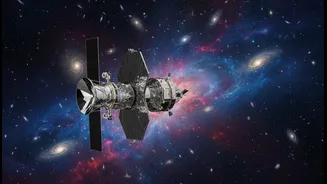
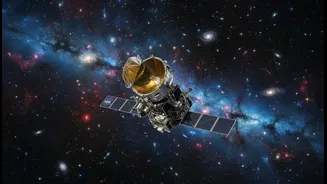
Imagine trying to create a map of a city by looking through a drinking straw. That’s been the challenge for telescopes like Hubble, which provide incredibly detailed but very narrow views. The Nancy Grace Roman Space Telescope, by contrast, offers a panoramic
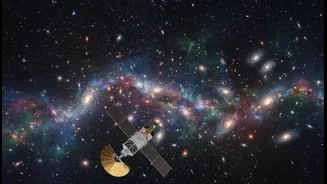
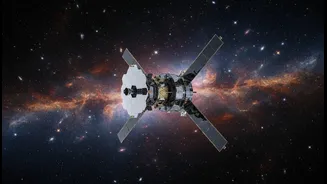
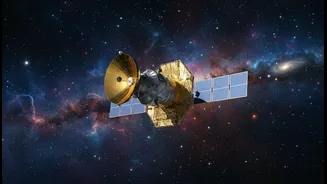
vista. Its Wide-Field Instrument (WFI) has a field of view 100 to 200 times larger than Hubble's infrared camera, while delivering the same stunning image quality. This means that in a single snapshot, Roman can capture a patch of the sky that would take Hubble hundreds of individual images to cover. This survey speed will allow astronomers to create vast, high-resolution maps of the universe far more efficiently than ever before, cataloging billions of galaxies and stars. The telescope itself is built around a 2.4-meter mirror, the same size as Hubble's, which was provided to NASA by the U.S. National Reconnaissance Office.
Hunting the Universe's Biggest Mysteries
Roughly 95% of the universe is made of dark matter and dark energy, mysterious components that we can't see or directly detect. Dark energy is the name given to the unknown force causing the universe's expansion to accelerate, while dark matter's gravity seems to hold galaxies together. Roman is specifically designed to attack these problems. By mapping the distribution of hundreds of millions of galaxies and tracking their distances using exploding stars called supernovae, the telescope will measure the history of cosmic expansion with unprecedented precision. These measurements will help scientists determine if dark energy is a constant force or if it has changed over cosmic time, a key question in modern cosmology. It will also study how dark matter is distributed by observing its subtle gravitational effects on the light from distant galaxies, an effect called weak gravitational lensing.
A Census of a Thousand New Worlds
Since the 1990s, astronomers have confirmed the existence of over 6,000 planets beyond our solar system, known as exoplanets. Roman is predicted to find around 100,000 more, potentially more than all other telescopes combined. It will primarily use two techniques. The first is the transit method, watching for the tiny dip in a star's light as a planet passes in front of it. The second is gravitational microlensing, a phenomenon where the gravity of a star and its planets can bend and magnify the light of a more distant star that passes behind it. This microlensing technique is sensitive enough to find planets down to the mass of Mars and even free-floating 'rogue' planets that don't orbit a star. By staring at the dense starfields in the center of our Milky Way galaxy, Roman will build a massive new catalog of worlds, helping us understand how common planets are across different galactic environments.
Testing Tech for Future Discoveries
Alongside its primary survey instrument, Roman carries a technology demonstrator called the Coronagraph Instrument. A coronagraph is essentially a highly sophisticated starlight-blocker, designed to suppress the overwhelming glare from a star to reveal the faint light of planets orbiting it. Directly imaging exoplanets is incredibly difficult, often compared to spotting a firefly next to a powerful spotlight. Roman’s coronagraph will be one of the most advanced ever flown in space, capable of imaging planets a billion times fainter than their host stars. While it will only observe a small number of nearby targets, its main purpose is to prove that this complex technology works in space. This will pave the way for future flagship missions, like the planned Habitable Worlds Observatory, which will use similar technology to search for signs of life in the atmospheres of Earth-like planets.