



A Telescope on Two Continents
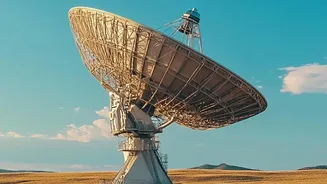
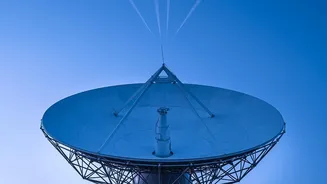
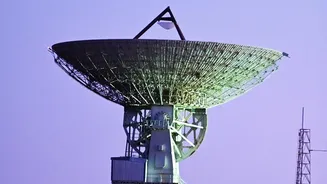
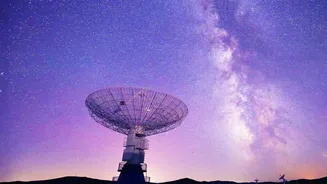
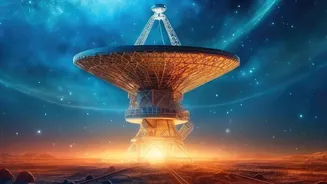
The Square Kilometre Array isn't a single telescope but a monumental project spread across two remote locations. In South Africa’s Karoo region, hundreds of 15-metre satellite dishes are being assembled for the SKA-Mid telescope. These dishes will focus
on mid-frequency radio waves. Meanwhile, in the Murchison region of Western Australia, a vast network of over 130,000 smaller, tree-like antennas will form the SKA-Low telescope, designed to capture low-frequency signals. This dual-site approach allows astronomers to observe the cosmos across a wide range of the radio spectrum simultaneously. Construction officially began in late 2022, marking a major milestone for the international consortium of countries behind this decades-long endeavour. The project's headquarters are located at the Jodrell Bank Observatory in the UK.
The Power of a Collective Eye
The genius of the SKA lies in a technique called interferometry. Instead of building one impossibly large dish, the SKA combines the signals from thousands of antennas spread over huge distances. In South Africa, the dishes will be scattered across 150 kilometres, while Australia's antennas will cover 74 kilometres. When these signals are synchronized and combined by some of the world's fastest supercomputers, they create a virtual telescope with a collecting area equivalent to one square kilometre. This gives the SKA unprecedented sensitivity and resolution, allowing it to see the universe in far greater detail than ever before. Recent tests in early 2026 successfully combined the signals from the first two SKA-Mid dishes, proving the concept works and marking the moment the telescope 'came alive' as a scientific instrument.
Tuning into the Cosmic Dawn
One of the SKA's primary missions is to capture signals from the very early universe, a period known as the Cosmic Dawn and the Epoch of Reionisation. This refers to the first billion years after the Big Bang, when the first stars and galaxies began to form, lighting up the cosmos. The SKA will be sensitive enough to detect the faint radio waves emitted by the vast clouds of neutral hydrogen gas that existed before these first stars were born. By mapping this gas, astronomers can essentially create a 3D picture of the early universe as it was taking shape, watching the births of the first stars and galaxies in a way no other telescope can. It’s a form of cosmic time travel, allowing us to witness a fundamental chapter in our universe's history.
A Universe of Discovery
While looking back to the beginning of time is a headline goal, the SKA's capabilities will transform many other areas of astronomy. Scientists will use it to test Einstein's theory of general relativity with extreme precision by observing pulsars, which are rapidly rotating neutron stars. The telescope will also hunt for the origins of cosmic magnetism, search for the complex organic molecules that are the building blocks of life, and shed new light on the mysterious forces of dark matter and dark energy, which are believed to make up 95% of the universe. Its incredible survey speed means it can map the entire sky thousands of times faster than current instruments, promising a flood of new discoveries.
A Deluge of Cosmic Data
Observing the universe with such detail generates an almost unimaginable amount of information. The data collected by the SKA each year is expected to reach over 700 petabytes, which is equivalent to the storage of about 1.5 million laptops. The raw data flowing from the antennas could exceed the entire global internet traffic. Managing, processing, and storing this data is one of the project's greatest technological challenges. It requires the development of new supercomputing facilities and a global network of regional data centres to make the information accessible to scientists worldwide. In preparation, the SKA Observatory has been running 'Data Challenges' to help the scientific community develop the skills needed to handle these massive datasets.