







What is the CAPSTONE Mission?
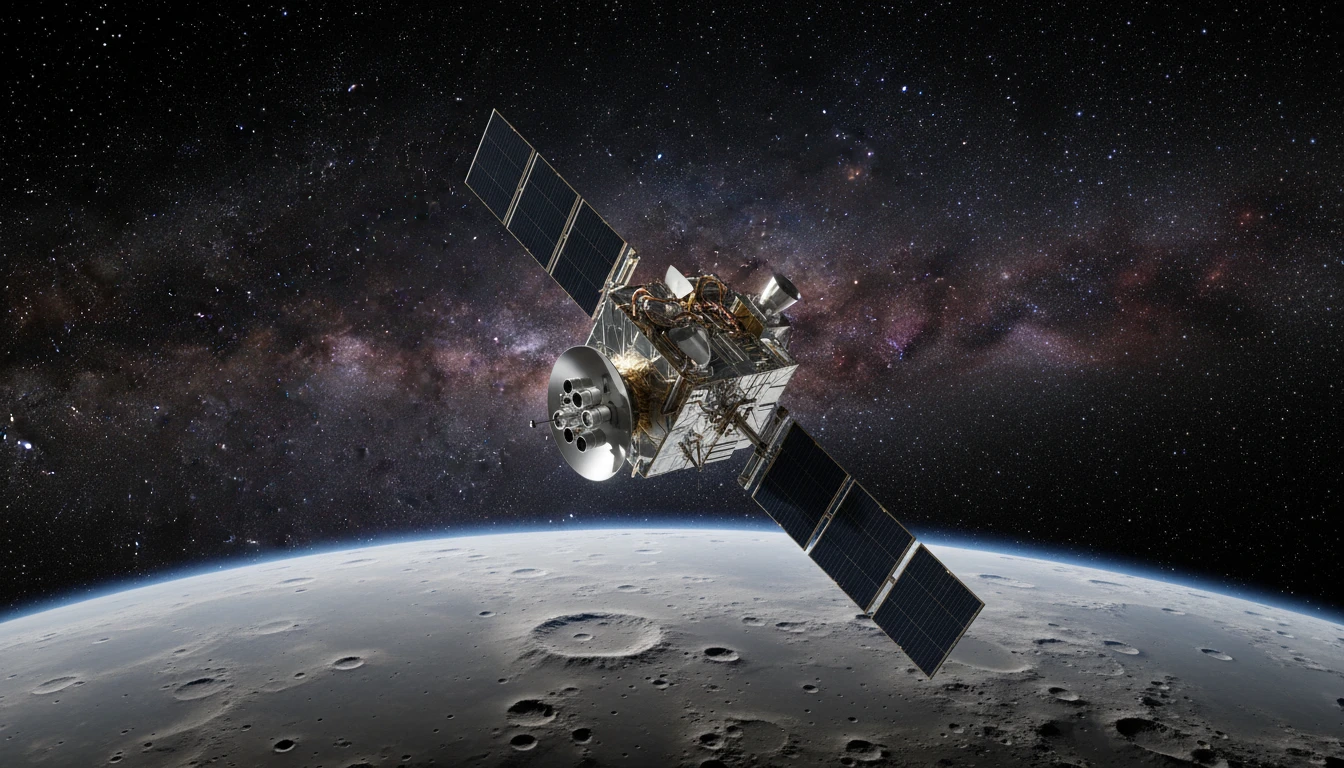
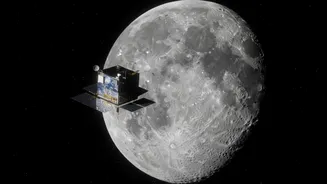
CAPSTONE, short for Cislunar Autonomous Positioning System Technology Operations and Navigation Experiment, is a small satellite, about the size of a microwave oven. Despite its small stature, it had a massive job: to be the very first to fly in a new,
special orbit around the Moon. Launched in June 2022, this 55-pound pathfinder was designed as a low-cost way to test the deep-space environment and reduce risks for future, more expensive missions. The mission was a partnership between NASA and several commercial companies, including Advanced Space, which owns and operates the spacecraft, demonstrating a new model for more affordable exploration. Its primary goal was to act as a trailblazer for NASA's Artemis program, which aims to establish a long-term human presence on and around the Moon.
A Mission Accomplished
In June 2026, NASA announced that CAPSTONE had officially achieved all of its primary and extended mission objectives, marking the successful conclusion of NASA's formal activities with the spacecraft. This final milestone confirmed that after nearly four years, the tiny satellite had delivered on all its promises. It initially completed its primary six-month mission back in May 2023 but was given a 15-month extension to serve as a testbed for new technologies. The completion of these extended goals represents the final validation of its capabilities, solidifying the wealth of data it provided to mission planners. While NASA's direct involvement has wrapped up, the spacecraft will continue to be operated by Advanced Space, potentially providing more insights for future missions.
A Unique Path: The Near Rectilinear Halo Orbit
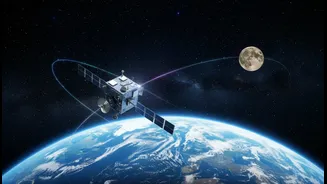
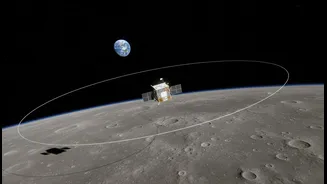
The key to CAPSTONE's importance is its destination: a Near Rectilinear Halo Orbit, or NRHO. Unlike the simple, circular orbits of the Apollo era, the NRHO is a highly elongated, seven-day loop around the Moon. It swings from as close as 1,600 kilometers over one lunar pole to as far as 70,000 kilometers from the other. This special path exists at a precise balance point between the gravities of the Earth and the Moon. This gravitational equilibrium means that a spacecraft in the NRHO needs very little fuel to stay in place, making it an incredibly stable and efficient spot for a long-term outpost. Before CAPSTONE, this orbit had only existed in computer simulations. CAPSTONE became the first spacecraft to ever fly this path, proving its viability for long-duration missions.
Paving the Way for the Lunar Gateway
The NRHO is the chosen orbit for the Lunar Gateway, a critical piece of the Artemis program's infrastructure. The Gateway is planned as a small space station that will orbit the Moon, serving as a command center, science lab, and way station for astronauts traveling to the lunar surface. Committing a multi-billion-dollar project like the Gateway to an untested orbit was a significant risk. CAPSTONE's mission was to eliminate that risk. By successfully entering and maintaining the NRHO, CAPSTONE provided real-world data confirming that NASA's models for power and propulsion needs were accurate. It effectively served as the surveyor, charting the territory and ensuring the path was safe for the much larger Gateway to follow.
More Than Just an Orbit
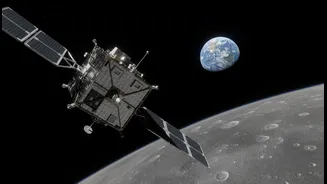
Beyond just testing the orbit, CAPSTONE's extended mission validated other crucial technologies. One major success was testing an autonomous navigation system, which allows a spacecraft to determine its position without constant contact with Earth. It even practiced this by communicating directly with NASA's Lunar Reconnaissance Orbiter (LRO) to determine its own location in space. CAPSTONE also tested advanced, disruption-tolerant communication protocols, which are essential for dealing with the delays and signal gaps inherent in deep space. These demonstrations proved that future missions could operate with more independence from ground control, a key requirement for establishing a sustained human presence on and around the Moon.
Strengthening the Artemis Generation
The success of CAPSTONE is a powerful demonstration of a new, more agile approach to space exploration. It showed that small, relatively inexpensive CubeSats can perform high-value science and pathfinding missions, significantly lowering the cost and risk of larger programs. The data gathered has given engineers and mission planners immense confidence in the viability of the NRHO and the design of the Lunar Gateway. By retiring major risks associated with the orbit, navigation, and communications, this small pathfinder has strengthened the foundation upon which the entire Artemis program is built. It has cleared the way, both literally and figuratively, for NASA's long-term plans to return humans to the Moon and, eventually, venture onward to Mars.