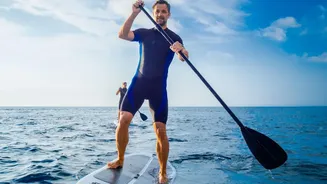







As more people in India trade the gym for the great outdoors, two activities stand out: hiking and paddleboarding. Both promise a great workout with a view, but which one truly offers better conditioning for your heart? Let's break it down.
The Heart of the Matter: Cardio Intensity
When it comes
to cardiovascular exercise, the goal is to elevate your heart rate and keep it there. Hiking is a classic aerobic activity that reliably gets your heart pumping. The varied terrain of a trail, with its inclines and declines, naturally pushes your heart to work harder to supply oxygen to your muscles. You can easily control the intensity; a brisk walk on a flat path is a moderate workout, while tackling a steep hill becomes a high-intensity session. This makes hiking a highly customisable cardio workout. Stand-up paddleboarding (SUP), on the other hand, offers a different kind of cardio challenge. While a calm, leisurely paddle might feel relaxing, it provides a steady, low-impact aerobic workout. The real cardiovascular benefits kick in when you increase your pace or face external factors like wind and water currents. The continuous motion of paddling ensures your heart rate stays elevated, similar to jogging or cycling. Moreover, the constant effort to maintain balance engages your entire body, demanding more from your cardiovascular system to keep everything working in unison.
Calorie Burn and Weight Management
Heart health is closely linked to maintaining a healthy weight, and that's where calorie burn comes in. Both activities are effective, but the numbers vary based on intensity and body weight. Hiking generally burns more calories per hour. A person can expect to burn between 400 and 600 calories an hour on the trail, with the exact number depending on the trail's difficulty and the weight of any backpack you might be carrying. Recreational paddleboarding on calm water burns approximately 300 to 430 calories per hour. However, this number can skyrocket with increased intensity. Vigorous SUP activities like racing or paddling in rough waters can burn over 600 calories, and in some cases, upwards of 700 to 1,000 calories per hour, putting it on par with high-intensity running. So, while hiking offers a more consistent high-calorie burn, paddleboarding has the potential for explosive calorie expenditure if you push the pace.
Full-Body Workout vs. Lower-Body Focus
A key difference lies in which muscles each activity targets. Hiking is predominantly a lower-body workout. It builds powerful glutes, quadriceps, hamstrings, and calves. Navigating uneven terrain also engages your core muscles for stability, but the main focus remains on your legs. Paddleboarding is celebrated as a true full-body workout. The most significant engagement is in the core muscles—your abs, obliques, and lower back—which are constantly firing to keep you stable on the board. The act of paddling provides a fantastic workout for your back, shoulders, and arms. Your legs and feet are also continuously working to make micro-adjustments for balance. This comprehensive muscle engagement means you are building functional strength across your entire body.
Joint Impact and Accessibility
For those with joint concerns, the difference is critical. Paddleboarding is a low impact exercise, meaning it's gentle on your joints like your knees and hips. This makes it an excellent choice for individuals recovering from certain injuries or those who find high impact activities like running painful. Hiking, while generally considered easier on the joints than running, can still be stressful, especially on steep downhill sections. However, its weight bearing nature is excellent for improving bone density. In terms of accessibility in India, hiking has a clear advantage. Trails can be found almost anywhere, from urban parks to the vast Himalayas. Paddleboarding requires access to a suitable and safe body of water—be it a calm lake, a river, or the sea—and the necessary equipment, which can be a bigger barrier for many.
The Verdict: Which is Better?
So, which activity wins for heart conditioning? The answer isn't a simple one. If your goal is a straightforward, accessible, and high calorie burning cardio workout that strengthens your lower body, hiking is an unparalleled choice. It's easy to start and easy to scale up in difficulty. If you're looking for a low impact, full body workout that builds incredible core strength, improves balance, and offers a unique on water experience, paddleboarding is superior. While a casual paddle is a lighter workout, it has a very high ceiling for intensity. The best exercise for your heart is ultimately the one you enjoy enough to do consistently. Both hiking and paddleboarding reduce stress and improve mental well being, which is also crucial for a healthy heart. One offers the grounding rhythm of your feet on the earth, the other the fluid challenge of gliding on water.