




Meet the 'Vanishing' Planet
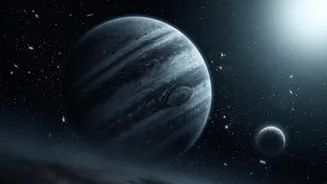
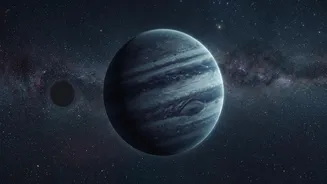
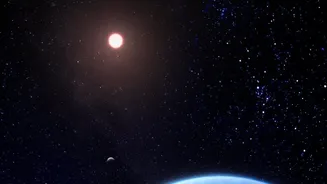
The planet at the centre of this mystery is TOI-2535 b, a type of exoplanet known as a 'hot Jupiter'. These are gas giants, similar in nature to our own Jupiter, but they orbit perilously close to their host stars. TOI-2535 b, which is about half the mass
of Jupiter, completes a full orbit around its star in just over eight Earth days, compared to Mercury's 88 days. For seven years, from 2019 to March 2026, astronomers using NASA’s Transiting Exoplanet Survey Satellite (TESS) watched it faithfully. They detected it using the 'transit method'—observing the tiny, regular dip in starlight as the planet passed in front of its star from our viewpoint. Then, in March 2026, the dips stopped. The planet, for all intents and purposes, had disappeared.
A Cosmic Wobble
So, what happened? The planet didn't get destroyed or fly off into deep space. Instead, its orbit was tilted. Think of the precise alignment needed to see a solar eclipse; the Earth, Moon, and Sun have to line up perfectly. It’s the same for exoplanet transits. The research, led by astronomers at the University of California, Los Angeles (UCLA), revealed that something was gravitationally pulling on TOI-2535 b, causing its orbit to wobble like a spinning top. This wobble, known as precession, gradually tilted its orbital path just enough that it no longer crosses the face of its star from our perspective on Earth. Before it vanished, astronomers noticed clues that something was amiss. The planet’s transits were erratic, sometimes arriving up to six hours early or late—a huge deviation that pointed to an outside influence.
The Hunt for the Unseen Neighbour
The culprit is believed to be a second, as-yet-unseen giant planet in the same system. While TESS couldn’t see this hidden world, its gravitational signature is written all over TOI-2535 b’s strange behaviour. By analysing the wobble and the irregular transit times, scientists have inferred the presence of this massive companion. The data suggests the unseen neighbour is at least the mass of Saturn and is in a slightly tilted orbit relative to TOI-2535 b. This misalignment creates a powerful gravitational tug-of-war between the two worlds, causing both of their orbits to precess over decades. This discovery is remarkable because it's the first time astronomers have directly observed a planet's transits ceasing due to this kind of orbital tilting.
Rewriting the Story of Hot Jupiters
The existence of this unseen neighbour does more than just solve a mystery; it challenges our understanding of how planetary systems form. Hot Jupiters like TOI-2535 b are a puzzle because they are too close to their stars to have formed there; the environment is too hot for large, icy gas giants to coalesce. The prevailing theory is that they form farther out and migrate inwards. One theory suggests this migration is violent, with the planet being 'flung' into a new, close orbit after a near-collision. However, the stable, long-term interaction with a nearby companion suggests a gentler path for TOI-2535 b. It likely migrated inward slowly, spiralling in along with the disc of gas and dust that originally formed the planets. This system provides a rare laboratory for studying a less common, but equally important, channel of planet formation.