



Seeing the Invisible
When we look up at the night sky, our eyes see visible light. But this is just a tiny fraction of the full spectrum of light that exists. Infrared light has longer wavelengths than visible light, which allows it to pass through clouds of cosmic gas and
dust that would normally block our view. This makes infrared astronomy a powerful tool for peering into regions of space that are otherwise obscured, like the dense hearts of galaxies and the stellar nurseries where new stars are born. Cooler objects, such as planets and the dust itself, glow brightly in infrared, providing a completely different perspective than a traditional telescope ever could.
A New Look at an Old Friend
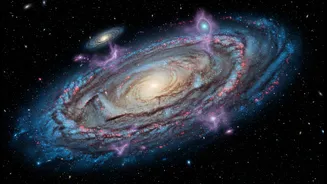
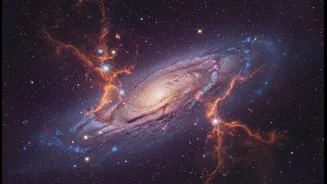
There are few galaxies more familiar to us than Andromeda (M31), our closest large spiral neighbor. In visible light, it's a majestic swirl of stars. But recent observations from powerful infrared telescopes like the James Webb Space Telescope (JWST) and the now-retired Spitzer Space Telescope are revealing its hidden skeleton. These new images cut through the galaxy's opaque dust lanes, transforming a well-known celestial object into a fresh landscape for research. What once appeared as dark, empty patches are now seen as intricate, glowing filaments of dust and gas, the raw materials for future generations of stars.
The Secrets of Stardust
These infrared views are providing unprecedented new insights. Astronomers can now map the structure of Andromeda's dust in stunning detail, including a massive ring of dust roughly 75,000 light-years across. Some researchers speculate this ring could be the result of a past collision with a smaller galaxy. By observing the glow of this dust, scientists can pinpoint active star-forming regions with incredible precision. The most recent images from JWST are so sharp that they can resolve individual stars even within the crowded galactic center, allowing for a kind of galactic archaeology—reading the history of the galaxy in its stellar populations.
Clues to a Violent Past
The infrared data doesn't just show where stars are being born; it also hints at the galaxy's violent history. For example, recent images of the galaxy Centaurus A, another nearby active galaxy, showcase the scars of a dramatic merger with another galaxy that occurred billions of years ago. The infrared view pierces through the chaotic dust to reveal how the galaxy's central supermassive black hole is actively shaping the galaxy around it by launching powerful jets of energy. Similarly, detailed infrared studies of Andromeda have revealed streams of dust flowing toward its own central black hole and even a hole in its dust ring where a dwarf galaxy may have punched through. These features, invisible in optical light, are crucial clues to understanding how galaxies evolve.
The Golden Age of Infrared
With instruments like JWST, astronomers are just beginning to scratch the surface of what infrared astronomy can reveal. These telescopes are not just taking prettier pictures; they are fundamentally changing our understanding of the universe. By looking back in time—since the light from distant objects has been traveling for billions of years—infrared telescopes can study the formation of the very first galaxies. Already, JWST has found galaxies in the early universe that appear more massive and chemically evolved than our models predicted, forcing scientists to rethink the cosmic timeline. Each new image from this new generation of observatories promises more discoveries, turning what we thought we knew on its head and opening up a universe of new questions.