



Meet NASA's Next Great Observatory
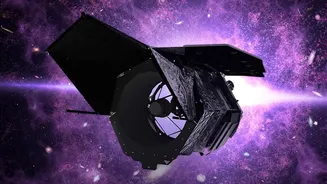
The Nancy Grace Roman Space Telescope is NASA's next flagship astrophysics mission, designed to build on the legacies of the Hubble and James Webb space telescopes. Named after Nancy Grace Roman, NASA’s first chief of astronomy, this observatory has a primary
mirror measuring 2.4 meters (7.9 feet) in diameter, the same size as Hubble's. However, its primary instrument gives it an extraordinary capability that sets it apart: a colossal field of view. This will allow Roman to map huge swathes of the sky with incredible speed and efficiency, fundamentally changing how astronomers conduct cosmic surveys.
The Power of a Panoramic View
The key to Roman's power lies in its Wide Field Instrument (WFI). Imagine looking at the night sky. Telescopes like Hubble and Webb are like looking through a narrow straw, allowing for incredibly deep and detailed views of a tiny patch of the cosmos. Roman, in contrast, is like looking through a giant picture window. Its field of view is at least 100 times larger than Hubble's infrared camera, allowing it to capture a vast cosmic panorama in a single snapshot. This means that in its five-year primary mission, Roman can survey more of the sky than Hubble has in over 30 years. This wide-angle lens, combined with Hubble-like image sharpness, will enable scientists to create unprecedented maps of the universe.
Unraveling the Mystery of Dark Energy
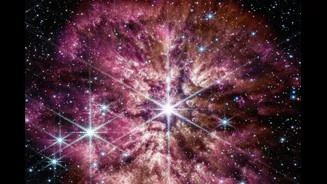
One of Roman's primary goals is to tackle one of the biggest puzzles in physics: dark energy. This mysterious force is causing the expansion of the universe to accelerate, but scientists don't know what it is or how it works. Roman will investigate it by mapping the positions and distances of billions of galaxies and thousands of exploding stars called supernovae. By creating a massive 3D map of the cosmos, astronomers can trace the history of cosmic expansion with extreme precision. This large-scale statistical data is crucial for testing different theories of gravity and understanding the nature of the force that is pushing the universe apart.
A Census of a Million New Worlds
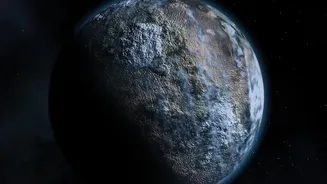
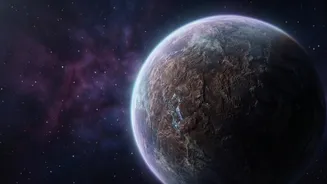
Beyond cosmology, Roman is set to revolutionize the hunt for exoplanets. While missions like Kepler and TESS have found thousands of planets using the 'transit' method (watching for a star's light to dim), Roman will primarily use a different technique called gravitational microlensing. This method detects planets by observing how their gravity, combined with their star's, bends and magnifies the light of a more distant, unrelated star that passes behind them. Microlensing is particularly effective at finding planets in wider orbits, similar to those in our own solar system, as well as rogue planets that drift through space without a host star. Scientists anticipate Roman will discover thousands of planets this way, providing a more complete census of the different types of planetary systems that exist in our galaxy.
A Cosmic Team Player
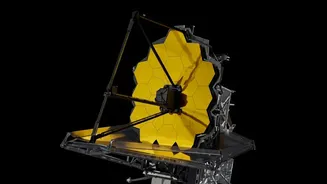
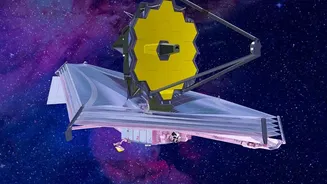
Roman isn't a replacement for Hubble or Webb; it's a powerful teammate. Think of Roman as the scout that maps the territory, while Webb is the specialist that zooms in for a detailed investigation. Roman’s wide-field surveys will identify unique and rare objects—primordial galaxies, distant supernovae, or unusual planetary systems—that Webb can then target for in-depth analysis. While Webb peers deeper into the infrared to see the very first galaxies forming, Roman will provide the broad context, showing how those structures are distributed across the universe and how they evolved over time. Together, these great observatories will give humanity its most complete picture of the cosmos yet.