






The Data Deluge from Deep Space
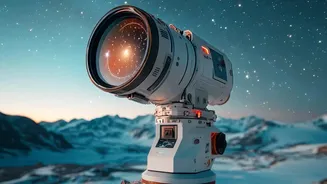
Modern astronomy faces a wonderful but overwhelming problem: there's too much data. Telescopes like NASA's James Webb and the Vera C. Rubin Observatory, which began operations in 2025, are capturing the cosmos in unprecedented detail. The Rubin Observatory alone
generates about 20 terabytes of data every single night. Over its ten-year survey, it will produce a 500-petabyte dataset. For context, that’s equivalent to streaming about 100 million high-definition movies. It's an amount so vast that no team of scientists could ever hope to manually sift through it all. This data deluge means countless discoveries are likely buried within the noise, waiting for a tool sharp enough to find them.
A New Generation of Planet Hunters
One of the most successful applications of AI in astronomy is the hunt for exoplanets, or planets outside our solar system. AI models, particularly neural networks, are trained to spot the tell-tale signs of a planet transiting, or passing in front of, its star. These events cause a minuscule dip in the star's light, a signal that can be easily missed by human observers amid instrumental noise and stellar variability. NASA's ExoMiner, a deep learning system, analyzed data from the Kepler Space Telescope and successfully identified 301 new exoplanets. More advanced AI can even predict the layout of entire planetary systems based on the first few planets discovered, making the search more efficient. This allows astronomers to focus their precious telescope time on the most promising candidates.
Listening for Whispers in the Static
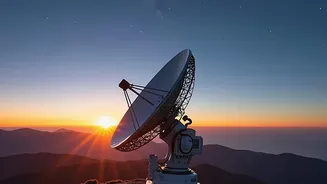
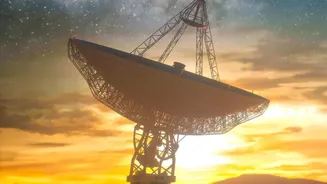
The search for extraterrestrial intelligence (SETI) is also being transformed by AI. For decades, SETI projects have scanned the skies for radio signals that stand out from the natural cosmic background noise. AI can take this search to a new level. Machine learning algorithms can be trained to identify faint or complex patterns in terabytes of radio telescope data that traditional methods would overlook. These systems learn to recognize the 'fingerprints' of known cosmic sources, like pulsars, and can then flag anything that deviates from the norm. This doesn't mean AI is guaranteed to find an alien broadcast, but it dramatically expands the scope and sensitivity of the search, allowing scientists to listen for more subtle and unusual types of signals across the entire sky.
Discovering the 'Unknown Unknowns'
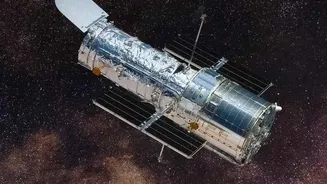
Perhaps the most exciting frontier for AI in space is its ability to perform anomaly detection—finding things we don't even know we should be looking for. Instead of searching for specific patterns, some AI models are trained on vast datasets to learn what is considered 'normal' in space. They then flag anything that doesn't fit. Using this method, an AI tool named AnomalyMatch recently scanned nearly 100 million images from the Hubble Space Telescope's archives in just a few days. It identified over 1,300 strange objects, including more than 800 that had never been documented. Most were interacting galaxies or gravitational lenses, but some defied easy classification. This approach turns AI into a serendipity engine, pointing human experts toward phenomena that could challenge our fundamental understanding of astrophysics.
Smarter, Safer, Faster Exploration
AI's role extends beyond just searching. It is crucial for the autonomous operation of spacecraft and rovers. NASA's Perseverance rover on Mars uses AI to navigate the planet's hazardous terrain in real-time and to autonomously select rock targets for chemical analysis, tasks that would be slow and cumbersome if fully controlled by humans on Earth. In the near future, fleets of robots could work together as an independent science team, with AI weighing risks against potential scientific rewards to decide which robot should investigate a point of interest. AI is also being used to manage the health of satellites, predict system failures, and track orbital debris to prevent collisions. This makes current and future missions not only more efficient but also significantly safer.