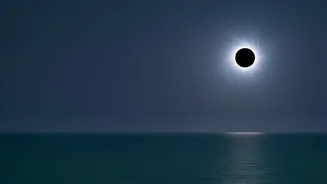







A Rare European Spectacle
A total solar eclipse happens when the Moon passes directly between the Sun and Earth, casting a narrow shadow, called the path of totality, onto the planet's surface. While a partial eclipse will be visible across most of Europe and parts of North America,
only those within this specific band will witness the main event. This path will begin over remote eastern Greenland, cross western Iceland, and then make landfall in northern Spain in the evening. Cities like A Coruña, Bilbao, and Palma are directly in the path of totality, making this one of the most accessible eclipses for a large population in decades. This accessibility is a key reason for the immense excitement, turning a remote astronomical event into a major public spectacle.
The Science of a Sunset Eclipse
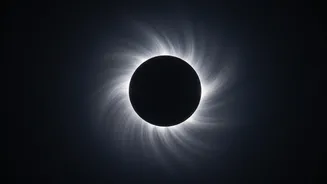
What makes the 2026 eclipse particularly fascinating for scientists and sky-gazers is its timing. In Spain, totality will occur late in the day, with the Sun low on the horizon. In some locations, like the Balearic Islands, the Sun will be just a few degrees above the horizon during the total phase. This creates a unique and challenging viewing opportunity. An eclipse near sunset could offer breathtaking photographic possibilities, with the Sun's corona—its ethereal outer atmosphere, only visible during totality—framed against a terrestrial landscape. However, it also means that a clear view to the western horizon is essential, as even distant hills or buildings could obscure the view. This low-on-the-horizon aspect presents a distinct set of conditions for scientific observation.
NASA's High-Altitude Mission
This is where the timeliness for NASA comes in. The agency isn't leaving the view to chance. To bypass potential weather issues like clouds and to get the clearest possible data, NASA will deploy its WB-57 high-altitude research aircraft. Flying at 50,000 feet, well above most of the atmosphere, the jet will chase the Moon's shadow over the Atlantic, west of Iceland. By flying along the eclipse path at over 700 kilometers per hour, the aircraft can extend the duration of totality for its onboard instruments from just over two minutes on the ground to nearly three minutes in the air. This extra time is invaluable for collecting high-quality data. Equipped with a suite of sophisticated cameras, the WB-57 will capture high-resolution images of the solar corona in multiple wavelengths of light, aiming to better understand its structure, its million-degree temperature, and how the solar wind is formed.
Studying the Sun's Mysterious Corona
The primary scientific target during any total solar eclipse is the corona. This faint, wispy layer is typically invisible, completely washed out by the bright face of the Sun. Only during the brief moments of totality can it be studied from Earth's vicinity. Each eclipse provides a snapshot of the corona in its current state, and since the Sun is an ever-changing star, every eclipse offers new information. Scientists are particularly interested in learning more about solar prominences and the complex magnetic fields that govern the corona's behavior. Improved models of the corona don't just help us understand our star; they are critical for improving space weather forecasts, which can impact satellites, communications, and even astronauts in space.
A Global Scientific Effort
NASA's airborne mission is just one part of a broad international effort. The European Space Agency (ESA) will also be conducting observations, and numerous research teams will be on the ground in Spain and Iceland. NASA is also sponsoring university-led projects, including the launch of high-altitude scientific balloons in both Spain and Iceland. These balloons will study how Earth's atmosphere responds to the sudden drop in sunlight and temperature during the eclipse. By comparing predictions from computer models with the real-world observations from the 2026 eclipse, scientists can refine their understanding of the Sun's intricate magnetic environment. This collaborative, multi-faceted approach underscores the rare and valuable opportunity this specific eclipse represents to the scientific community.