


A Cosmic Sweet Spot
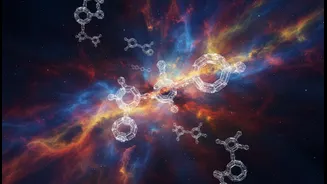
Scientists have announced the first-ever detection of ribose, a specific type of sugar, within samples of meteorites that have crashed into Earth. This isn't the kind of sugar you'd stir into your tea; ribose is a fundamental building block of life, and
finding it in rocks from space has sent waves of excitement through the scientific community. The discovery was made by an international team of researchers who meticulously analysed powder from two different meteorites. Using highly sensitive techniques, they identified not just ribose but other related sugars like arabinose and xylose, confirming that these vital molecules can and do form in extraterrestrial environments and survive the harsh journey through space. This confirms a long-held scientific hypothesis and opens a new chapter in our search for origins.
The Backbone of Life
So, what makes this particular sugar so special? Ribose is the crucial sugar component of ribonucleic acid, or RNA. Many scientists subscribe to the 'RNA World' hypothesis, a theory that suggests RNA, not DNA, was the primary genetic material for the earliest life forms on our planet. RNA is simpler than DNA and can perform multiple jobs, acting as both a carrier of genetic information and a catalyst for chemical reactions. For life to begin, there must have been a ready supply of its key components, including ribose. Finding this exact molecule in a meteorite strongly suggests that these essential ingredients could have been delivered to a young, sterile Earth by a bombardment of asteroids and comets billions of years ago, providing the raw materials needed for the first life to emerge from the primordial soup.
Proving Its Alien Origin
A major challenge in this kind of research is proving that the discovered molecules are truly extraterrestrial and not just contamination from our own planet's biology after the meteorite landed. The scientific team addressed this head-on with clever chemical analysis. By studying the specific type of carbon atoms within the sugar molecules, they were able to show that they were 'heavy' in a way that is characteristic of material formed in space, not on Earth. Terrestrial life has a preference for a lighter form of carbon. This isotopic signature was the smoking gun, giving the researchers confidence that the ribose was synthesized in space long before it fell to Earth. This rigorous verification is what makes the discovery so robust and significant, moving the idea from theory to observed fact.
A New Recipe for Research
This discovery doesn't just answer an old question; it inspires a dozen new ones. It galvanises scientists in a field known as astrochemistry to refine their models of how complex organic molecules form in interstellar clouds and asteroid belts. Now that they know ribose can form, they can design laboratory experiments that simulate space-like conditions to figure out the precise chemical pathways involved. It also adds immense excitement and purpose to sample-return missions. Spacecraft that have collected samples from asteroids and are returning them to Earth may be carrying even more pristine examples of these life-giving molecules. The analysis of these new samples will be a top priority, as they will be free from the complication of terrestrial contamination.