



The Original Game-Changer
In 1986, director Tony Scott sought to immerse audiences in the world of naval aviators in a way that had never been seen before. Inspired by an article on the Navy's elite fighter pilot program, he and producers Jerry Bruckheimer and Don Simpson were
determined to capture the raw intensity of flying an F-14. At a time when stock footage and rear projection were the norms for aerial sequences, Scott insisted on realism. Working closely with the U.S. Navy, the production gained unprecedented access to aircraft carriers and active-duty jets. Custom camera mounts were engineered to film real F-14 Tomcats in flight, capturing dynamic and visceral sequences that gave the film a documentary-like feel. The result was a visual language of quick cuts and dramatic angles that put the viewer directly in the danger zone, setting a new benchmark for military action storytelling.
A Three-Decade Push for Perfection
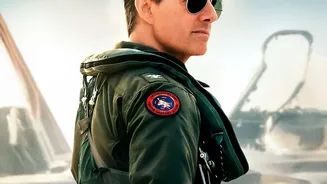
The massive success of 'Top Gun' begged for a sequel, but Tom Cruise, the franchise's star and driving force, refused to proceed until technology could properly capture the authentic experience of a modern fighter pilot. For years, the limitations of CGI and the immense logistical hurdles of practical filming kept the project grounded. Cruise's vision was clear: he didn't want the actors performing against a green screen. He wanted the audience to see and feel the gravitational forces pulling on the actors' faces. This unwavering commitment to practical effects became the sequel's guiding principle, setting it apart in an era dominated by digital spectacle. The challenge was no longer just about filming jets, but about putting the cast inside them.
The 'Maverick' Method: More Than Just Acting
To achieve this vision for 'Top Gun: Maverick,' Cruise designed an intensive, three-month flight training program for the young cast. This regimen, which condensed two years of flight school into a fraction of the time, was everything Cruise wished he'd had on the original film. The actors started in single-engine Cessnas to learn spatial orientation, then graduated to aerobatic planes to build up their G-force tolerance, and finally progressed to the F/A-18 Super Hornet. But their job didn't stop at enduring the flight. Director Joseph Kosinski and cinematographer Claudio Miranda worked with the Navy to install six IMAX-certified Sony VENICE cameras inside each cockpit. The actors essentially became their own camera operators and directors, responsible for their performance, camera operation, and timing, all while withstanding the crushing physical strain of high-G maneuvers.
The Authenticity of G-Force
The decision to film practically was not just for show; it was foundational to the performances. The visible strain, the subtle shifts in breathing, and the sheer physical pressure on the actors' faces are not special effects—they are real reactions. This is a level of authenticity that even the most advanced CGI struggles to replicate, as digital creations often lack the instinctive sense of weight and physical interaction that audiences perceive. When viewers see Miles Teller or Monica Barbaro being pinned to their seats, they are witnessing a genuine physical experience, creating a far more immersive and emotionally resonant connection than a performance on a soundstage ever could. This raw realism is the franchise's secret weapon, turning breathtaking stunts into gripping human drama.
Setting a New Cinematic Standard
The historic success of 'Top Gun: Maverick' was a direct result of this radical commitment to practical filmmaking. By pushing the boundaries of what was thought possible, the film offered an unparalleled cinematic experience that left audiences breathless. The complex aerial choreography, captured with groundbreaking camera technology like the tethered Rialto system and a variety of specialized lenses, created a spectacle that felt both epic and intimate. The franchise's legacy is not just one of thrilling dogfights and iconic characters, but a testament to the power of in-camera artistry. It proved that in an age of digital saturation, there is still a powerful audience appetite for the tangible, the risky, and the real, setting a new and incredibly high bar for the future of action cinema.