







The Tyranny of the Tracking Sheet
For many of us, the journey towards healthier eating begins with an app or a spreadsheet. The logic seems sound: calories in versus calories out. But this method, while effective for some, can quickly become a source of significant stress. The constant
vigilance, the mental maths before every meal, and the guilt associated with going 'over' your limit can transform food from a source of pleasure and nourishment into a source of anxiety. This hyper-focus on numbers can disconnect us from our body's natural hunger and satiety cues. Instead of asking, 'Am I full?' we ask, 'How many calories do I have left?' This can lead to a fraught relationship with food, where we ignore our body’s wisdom in favour of a digital tracker’s rigid rules.
A More Intuitive Approach: Macronutrients
Instead of zooming in on individual calories, let’s zoom out to the bigger picture: macronutrients. These are the three main building blocks of our food: protein, carbohydrates, and fats. A 'macro-balanced' meal is one that includes a healthy portion of all three. This approach shifts the focus from restriction to inclusion. Your goal is no longer to eat as little as possible, but to build a complete, satisfying plate. Protein provides building blocks for muscle and keeps you full. Complex carbohydrates offer sustained energy. Healthy fats support brain function and hormone production. By ensuring each meal contains these elements, you naturally create a plate that is both satiating and nutritionally sound, often without needing to count a single calorie.
The Humble Lentil's Superpower
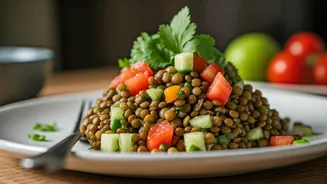
This is where the humble dal, a staple in every Indian kitchen, becomes a hero. Lentils are a nutritional powerhouse perfectly suited for the macro-balanced approach. They are an excellent source of plant-based protein, crucial for satiety and muscle repair. They are also packed with dietary fibre and complex carbohydrates, which digest slowly, providing a steady release of energy and preventing the blood sugar spikes and crashes associated with refined carbs. This combination of protein and fibre is what makes lentils so incredibly filling, helping you feel satisfied for longer. By making lentils a cornerstone of your meal, you’ve already checked the boxes for protein and complex carbs, making it far easier to build a balanced plate around them.
How to Build Your Perfect Lentil Plate
Visualise your plate as a simple guide. This isn't about precise measurements, but about proportions. 1. **Half Your Plate: Vegetables.** Fill half your plate with non-starchy vegetables. Think spinach, bhindi, cauliflower, bell peppers, or a large salad. These are rich in vitamins, minerals, and fibre, adding volume and nutrients with minimal caloric density. 2. **One Quarter: Lentils (Your Protein).** Dedicate one quarter of your plate to a generous serving of dal, lentil curry, or a lentil-based salad. This is your protein anchor that will provide lasting fullness. 3. **One Quarter: Complex Carbs & Healthy Fats.** The final quarter can be a source of additional complex carbs like a small portion of brown rice, quinoa, or a whole-wheat roti. To incorporate healthy fats, you can use a light tadka of ghee or oil in your dal, add a sprinkle of seeds, or have a side of yoghurt.
Freedom From Food Stress
Embracing this method does more than just simplify mealtime. It reframes your entire relationship with food. You start thinking in terms of nourishment, not numbers. It encourages you to eat a wider variety of whole foods, especially vegetables, rather than hunting for low-calorie processed snacks. Most importantly, it empowers you to listen to your body. When you eat a truly satisfying, balanced meal, you are less likely to experience intense cravings or mindless snacking. You regain a sense of trust in your own appetite and learn to eat until you are comfortably full. This is food freedom—a sustainable, stress-free path to wellness that no calorie-counting app can offer.