







A New Shape Emerges
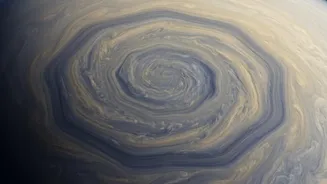
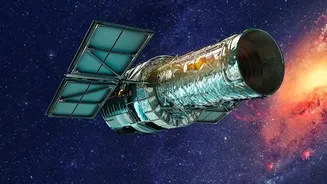
In a remarkable discovery, astronomers using NASA's Hubble Space Telescope have confirmed the existence of a massive, 10-sided atmospheric wave pattern encircling Saturn's south pole. This feature, dubbed the “decagon,” marks the first time such a regular,
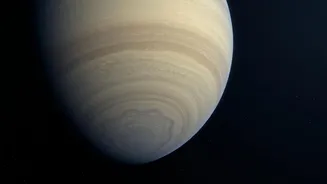
many-sided pattern has been observed in the planet's southern hemisphere. Hints of the structure first appeared in images captured by amateur astronomers in 2024, which prompted professional researchers to take a closer look with Hubble. By analyzing data going back to 2023, they found that the decagon has been growing more distinct over time, suggesting it is a newly forming phenomenon. This gives scientists a rare and exciting opportunity to watch a giant planetary weather system develop in real-time. The discovery was only possible because Saturn’s 29-year orbit and seasonal tilt are slowly bringing its south pole back into view from Earth, a region that was largely hidden when NASA's Cassini spacecraft was studying the planet.
The Decagon vs. The Hexagon
For decades, the only known planetary polygon was Saturn's northern hexagon, a six-sided jet stream that has been raging for at least 40 years. At first glance, the new decagon seems like a southern twin, but there are crucial differences. Most obviously, one has ten sides while the other has six. The southern decagon is also located at a lower latitude (around 60 degrees south) compared to the northern hexagon (at 78 degrees north). Furthermore, the hexagon is famously stationary, rotating at almost the same speed as the planet itself, making it a fixed feature. In contrast, the new decagon drifts slowly eastward. Scientists believe the northern hexagon is a mature, stable system, whereas the southern decagon appears to be a more dynamic and perhaps less stable feature that has only recently taken shape. When the Cassini probe studied the south pole during its summer season, it saw a powerful vortex, but no persistent polygonal shape was present.
The Science of Planetary Polygons
So, why do these geometric shapes form at all? The answer lies deep within the planet's atmosphere and the physics of its powerful jet streams. On a gas giant like Saturn, with no solid landmass to disrupt airflow, jet streams can flow in remarkably straight lines. These rivers of gas, moving at hundreds of miles per hour, can become unstable. Scientists believe these polygons are a type of 'standing wave'—a meandering in the jet stream that becomes locked into a stable, repeating pattern that circles the pole. Laboratory experiments have shown that by rotating a tank of liquid at different speeds, similar polygonal shapes can be created in the turbulent area between the different fluid flows. The number of sides—whether it’s six, ten, or another number—depends on the specific conditions of the atmosphere, such as the wind speeds and temperature gradients. The shape is not a solid structure, but a wave pattern in the clouds that extends deep into the atmosphere.
A Mystery in the Making
The discovery of the decagon has opened up a new chapter in our understanding of Saturn. It proves that the northern hexagon is not as unique as once thought and that Saturn's atmosphere is capable of forming these incredible structures in both hemispheres. The biggest question now is, why did it form now? The Cassini mission, which ended in 2017, saw no hint of it. This suggests the decagon is a recent development, possibly linked to the changing seasons on Saturn, where each season lasts for more than seven Earth years. As Saturn's southern hemisphere continues its slow tilt toward the sun and into a better view from Earth, scientists will be watching closely. They will track how the decagon evolves, whether it stabilizes into a long-lasting feature like its northern counterpart, or if it dissipates over time. Studying its formation could provide invaluable clues about the complex forces that drive the weather on gas giants and, by extension, on planets everywhere.