




The Problem with Prolonged Sitting
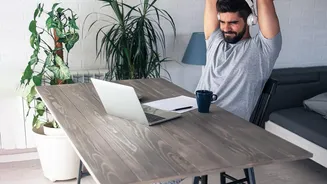
A sedentary job doesn't just feel restrictive; it actively changes your body. When you sit for hours, your hip flexors shorten and tighten, while your glute muscles can become weak and inactive—a phenomenon sometimes called 'gluteal amnesia'. This combination
forces your lower back and hamstrings to compensate, often leading to strain and discomfort. Meanwhile, a forward-leaning posture can cause your shoulders to round and your upper back (thoracic spine) to become stiff, limiting your range of motion and contributing to a slumped posture. The goal of a targeted routine is to reverse these patterns by 'waking up' underused muscles and restoring movement to stiff joints.
Foundation: Glute Bridges
Glute bridges are fundamental for desk workers because they directly counteract inactive glutes. Strong glutes support your pelvis and take pressure off your lower back. To perform one, lie on your back with your knees bent, feet flat on the floor hip-width apart, and your arms by your sides. Brace your core and squeeze your glutes to lift your hips toward the ceiling until your body forms a straight line from your shoulders to your knees. Pause at the top for a moment before slowly lowering back down. Focus on the mind-muscle connection, ensuring it's your glutes doing the work, not your lower back.
Core Stability: The Bird-Dog
The bird-dog is an excellent exercise for building stability through your deep core and along your spine. It challenges your balance and coordination without putting stress on your back. Start on all fours in a tabletop position, with your hands directly under your shoulders and your knees under your hips. Keeping your back flat and core engaged, extend your right arm straight forward and your left leg straight back simultaneously. Hold for a few seconds, focusing on preventing your hips from rotating. Return to the starting position with control and repeat on the other side. This movement trains your core to resist twisting, which is crucial for protecting your spine.
Hip Mobility: Deep Squat Hold
Sitting for long periods leaves your hips feeling tight and restricted. The deep squat hold, sometimes called a 'Grok Squat', is a primal movement pattern that helps open the hips, stretch the lower back, and improve ankle flexibility. Stand with your feet slightly wider than shoulder-width apart, toes pointing slightly outward. Lower your hips down as if sitting in a low chair, going as far as you can while keeping your heels on the ground and your back relatively straight. You can hold onto a stable object for support if needed. Hold this position for 30 to 60 seconds, breathing deeply to help your muscles relax into the stretch.
To undo the 'desk hunch', you need to restore rotation to your thoracic spine. A simple way to do this is with seated or quadruped thoracic rotations. In a chair, sit tall and cross your arms over your chest. Slowly rotate your upper body from side to side without moving your hips. Alternatively, start on all fours. Place one hand behind your head, then rotate that elbow up toward the ceiling, following it with your eyes to open up your chest. Slowly bring the elbow back down and toward your opposite arm. These movements help counteract the stiffness that develops from staring at a screen for hours.
Combining these movements into a consistent routine is key. You don't need to spend hours in the gym; a focused approach is more effective. Aim to perform this routine two to three times per week. You can structure it as a circuit, performing one set of each exercise before resting and repeating for a total of three rounds. For each exercise, aim for 10–15 repetitions, focusing on controlled movement and proper form. For the deep squat hold, focus on duration. This blend of activation, strength, and mobility provides a powerful antidote to a day spent in a chair, helping you move better and feel stronger.