


The Promise of an Unhackable Sky
At its core, the race for quantum satellites is about building a new kind of internet—one secured not by complex math that could one day be broken, but by the fundamental laws of physics. The key technology is called Quantum Key Distribution (QKD). Think
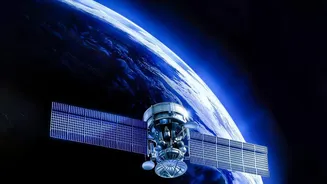
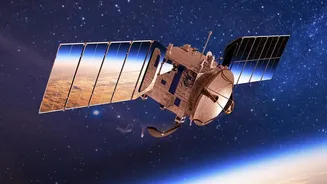
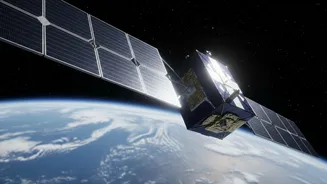
of it like creating a secret key to lock and unlock data, but with a special twist. The key is encoded onto individual particles of light, or photons. According to quantum mechanics, the very act of a third party trying to intercept and measure one of these photons will disturb its state, immediately revealing the eavesdropper's presence to the legitimate users. This makes the key—and therefore the communication it protects—provably secure. While fiber optic cables can carry these quantum keys on the ground, their signals degrade significantly after a couple hundred kilometers, making a global network impossible with fiber alone. Satellites are the answer, capable of acting as trusted nodes to relay quantum keys across continents and oceans.
From Lab Bench to Launchpad
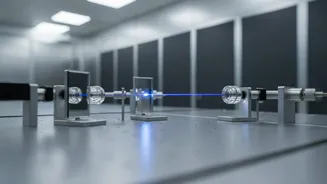
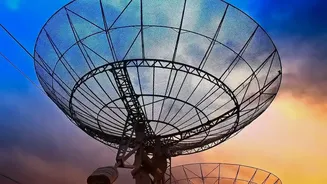
Sending a fragile quantum signal into space is incredibly difficult. The headline's mention of a "300-metre test" points to the crucial, unglamorous work that happens on the ground long before any satellite is launched. Scientists must prove their systems can transmit photons through the atmosphere, which is like trying to throw a microscopic grain of sand through a hurricane. Turbulence, weather, and light pollution can all destroy the delicate quantum information. Ground-based tests over hundreds of meters are designed to simulate the final, difficult leg of a satellite-to-ground transmission. These experiments validate that the hardware—the photon sources, detectors, and pointing systems—can overcome atmospheric interference before they are miniaturized and hardened for the brutal environment of space. Recent breakthroughs have even shown that sending signals up from Earth to a satellite, once thought impractical, is feasible, which could make future quantum satellites simpler and cheaper.
The New Global Space Race
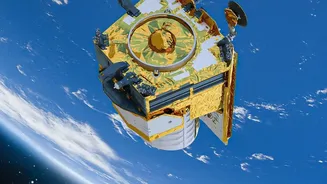
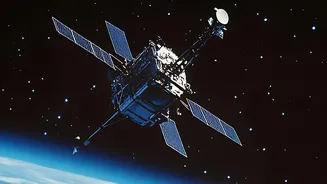
This technological frontier has sparked a new kind of space race, one focused on information supremacy rather than lunar landings. China is the undisputed early leader, having launched the Micius satellite back in 2016. Micius has successfully demonstrated intercontinental QKD between China and Austria and has been used for secure video calls. More recently, a Chinese microsatellite named Jinan-1 was reportedly used to establish a quantum communication link over a staggering 12,900 kilometers. In response, Europe and North America are accelerating their own efforts. The European Space Agency (ESA) is backing projects like the QKDSat to boost Europe's capabilities in secure communications. Meanwhile, the U.S. is investing heavily through NASA and the Space Force, focusing not only on communication but also on a wider array of quantum technologies for space. This global competition underscores the massive strategic and economic stakes, from protecting military and financial data to establishing the infrastructure for the next generation of computing.
More Than Just Secure Messages
While unhackable communication gets the headlines, it’s only the beginning. Quantum technology is set to revolutionize other space applications by enabling measurement with almost unimaginable precision. Quantum sensors could lead to hyper-accurate navigation systems that work even when GPS is jammed or unavailable—a critical capability for both military and deep-space exploration missions. These sensors could also be used for Earth observation, detecting tiny gravitational fluctuations to map underground water reserves, monitor melting ice sheets, or even predict natural disasters with greater accuracy. There is also the future vision of a true "quantum internet," a network that would link powerful quantum computers around the globe, enabling breakthroughs in fields like materials science and drug discovery. In this vision, satellites act as the essential long-haul data links, connecting quantum data centers across continents.