


A Telescope That's a Time Machine
The James Webb Space Telescope (JWST) is not just powerful; it's a veritable time machine. Because light takes time to travel across the vastness of space, looking at the most distant galaxies means we are seeing them as they were billions of years ago.
The JWST is specifically designed to capture infrared light, which is crucial because the light from the universe's first stars and galaxies has been stretched into these longer wavelengths by the expansion of the universe. This allows astronomers to peer back to a time just a few hundred million years after the Big Bang, an era that was previously just a blurry smudge in the images from older telescopes. Programs like JADES (JWST Advanced Deep Extragalactic Survey) and PRIMER (Public Release IMaging for Extragalactic Research) are surveying deep patches of the sky to find and study these cosmic infants.
What the New Images Reveal
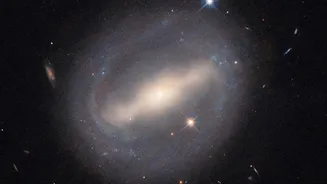
These new deep-field images are teeming with galaxies—far more than theories predicted. The JADES program, for instance, has uncovered hundreds of galaxies that existed when the universe was less than 600 million years old. What’s surprising scientists is not just the sheer number of these early galaxies, but their characteristics. Many appear brighter, more massive, and more structured than expected for such a young age. Astronomers are finding galaxies crackling with intense bursts of star formation, filled with hot, massive stars. In some cases, Webb has found galaxies that seem to have already stopped forming stars, a state known as quiescent, much earlier than previously thought possible. These findings are creating new tensions in our understanding of the cosmos.
Challenging the Cosmic Rulebook
The standard model of cosmology suggests that galaxies start small and messy, gradually merging and growing over billions of years into the grand spirals and ellipticals we see today. However, some of Webb's discoveries are forcing a rethink. Finding well-formed, massive galaxies so early suggests that the processes of galaxy and star formation might have been much more efficient in the early universe than our models accounted for. While these findings don't break our fundamental understanding of physics, they do require scientists to revisit their assumptions about how quickly gas can cool to form stars, how supermassive black holes grow, and how the first heavy elements were created and distributed.
Peering Through the Dust
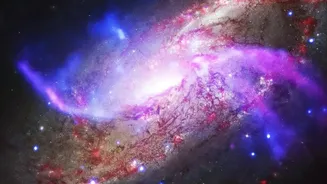
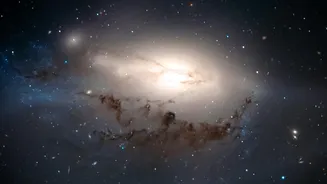
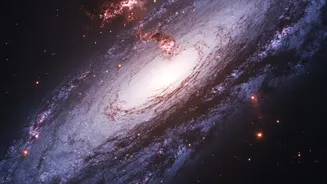
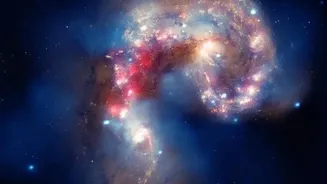
One of Webb's superpowers is its ability to see through cosmic dust. Using its Mid-Infrared Instrument (MIRI), astronomers can study the hidden birthplaces of stars and the structure of galaxies that are obscured in visible light. For example, recent fourth-anniversary images of Centaurus A, a nearby galaxy known for its dramatic dust lanes from a past collision, reveal its core in unprecedented detail. Webb cut through the dust to show a tapestry of individual stars and the activity around its central supermassive black hole. This same capability allows astronomers to study dust-enshrouded star formation in the very early universe, revealing that the relationship between dust and star birth might have been different billions of years ago.
The Next Chapter in Cosmic History
Every new image from the JWST opens up new questions. Astronomers are now using its powerful spectrographs, like NIRSpec, to do more than just see these distant galaxies; they are analyzing their light to understand their chemical composition and the motions of their gas. This helps confirm their immense distances and provides clues about the types of stars that existed and the mechanisms that shaped them. The data gathered by Webb is helping scientists trace the timeline of cosmic reionization—the period when the first stars burned off the opaque fog of hydrogen that filled the early universe. By building a larger sample of these primordial galaxies, astronomers hope to create a more complete map of the universe's structure and its evolution from chaos to cosmos.