


The Cosmic Shooting Gallery
Our solar system is a busy place, filled with remnants from its formation 4.6 billion years ago. Millions of asteroids, ranging from small boulders to dwarf planets, orbit the Sun. Most keep to the main asteroid belt between Mars and Jupiter, but some
have orbits that bring them into Earth’s neighbourhood. These are known as Near-Earth Objects (NEOs). While the planet has been hit by asteroids for its entire history, we are now the first generation with the technology to see them coming. An object doesn’t need to be a 'planet-killer' to cause significant damage; the 20-metre meteor that exploded over Chelyabinsk, Russia, in 2013 injured over a thousand people. NASA's Planetary Defense Coordination Office (PDCO) is tasked with finding NEOs larger than 30 to 50 meters, a size that could cause major regional damage if an impact occurred.
A Global Network of Eyes
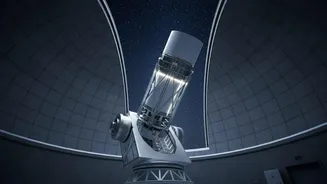
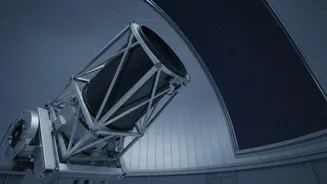
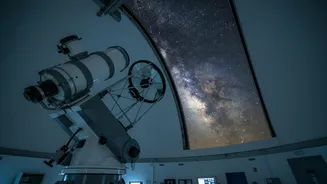
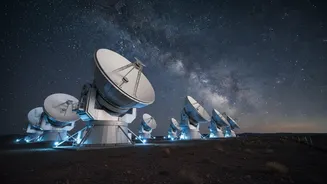
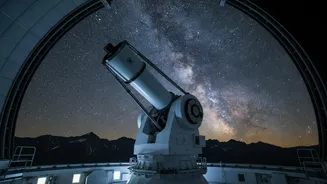
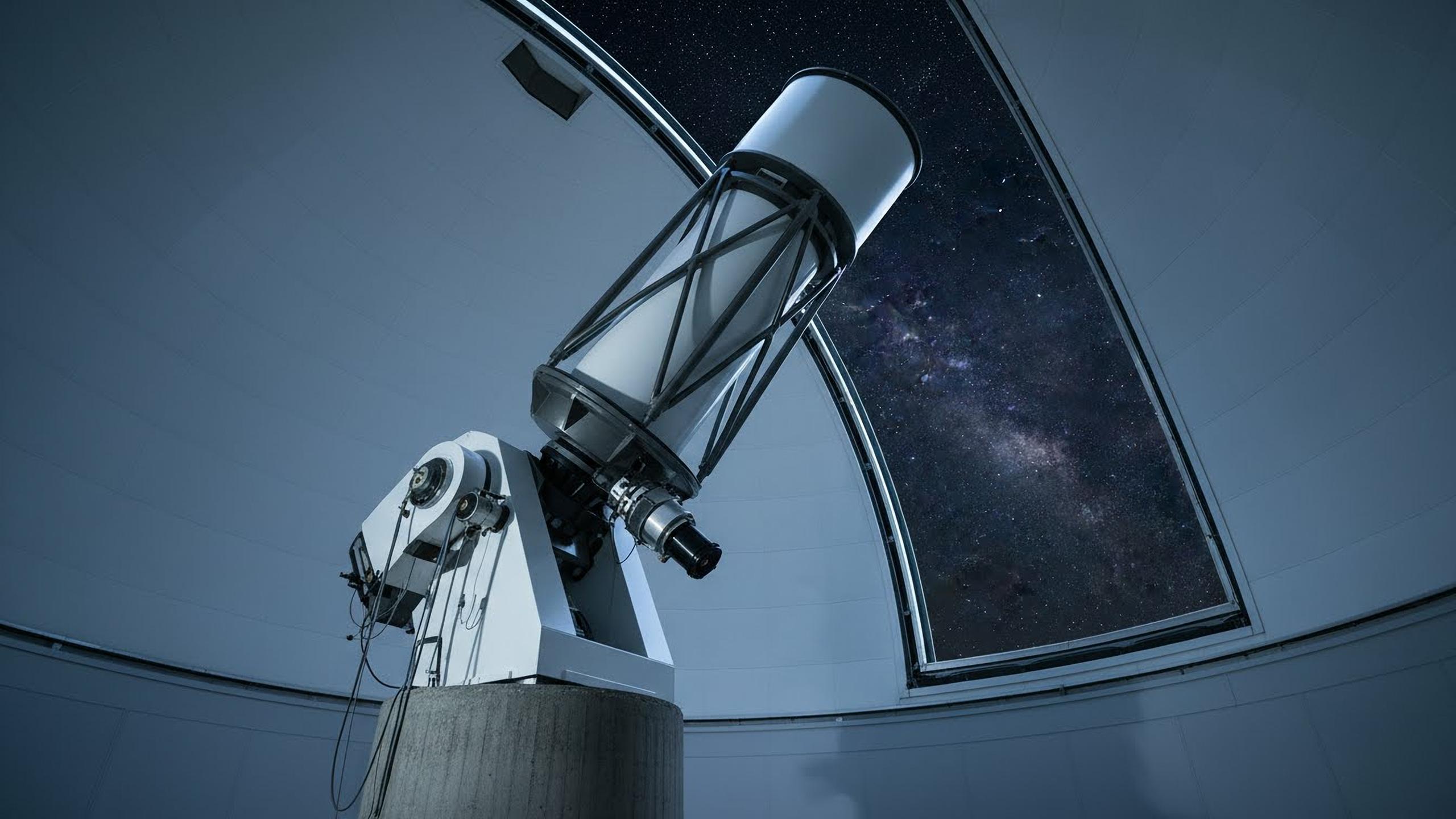
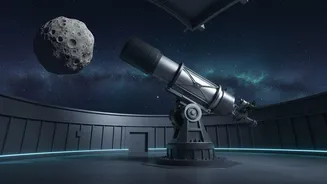
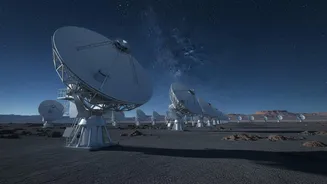
Detecting these relatively small, dark objects against the black of space is a monumental task. No single telescope can do it alone. Instead, we rely on a coordinated, global network of observatories. Key players include the Catalina Sky Survey in Arizona, the Pan-STARRS telescopes in Hawaii, and the Asteroid Terrestrial-impact Last Alert System (ATLAS), which has telescopes in Hawaii, Chile, and South Africa. These ground-based surveys are soon to be powerfully augmented by the Vera C. Rubin Observatory in Chile, which is expected to discover millions of new asteroids. This international collaboration is essential, and it's organized under frameworks like the International Asteroid Warning Network (IAWN), which was recommended by the United Nations to coordinate the global response to the NEO impact threat.
A 24/7 Celestial Relay Race
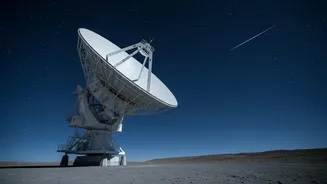
The “non-stop” nature of this work is literal. As the Earth rotates, one part of the world spins into darkness while another greets the dawn. To maintain continuous coverage, the responsibility of scanning the skies is passed like a baton in a relay race. A telescope in Arizona might track an object until sunrise, at which point an observatory in Hawaii takes over, followed by one in Chile or Australia. The ATLAS system, for instance, with its stations in both the Northern and Southern hemispheres, is now capable of scanning the entire dark sky every 24 hours. This unbroken chain of observation is crucial because the sooner a potentially hazardous asteroid is detected, the more time humanity has to react.
From Pixels to Predictions
Spotting an asteroid begins by taking multiple images of the same patch of sky minutes apart. Automated software then compares these images, looking for any point of light that has moved against the fixed background of stars. Once a candidate is flagged, its position is sent to the Minor Planet Center (MPC), an international clearinghouse for all asteroid and comet observations. Other astronomers around the world—both professional and amateur—then perform follow-up observations to help refine the object's path. This data flows to centres like NASA's Center for Near-Earth Object Studies (CNEOS), which calculates a high-precision orbit and projects its path for the next century to determine any potential impact risk.
More Than Just Watching
Planetary defense is moving beyond simply watching and waiting. The goal is to develop the capability to act if a genuine threat is found. In 2022, NASA’s Double Asteroid Redirection Test (DART) mission proved that we can change an asteroid's trajectory. The spacecraft successfully slammed into the small asteroid Dimorphos, altering its orbit—a historic first test of a potential deflection technique. While DART was a proof-of-concept, future missions like the NEO Surveyor, an infrared space telescope, will dramatically accelerate our ability to find hazardous asteroids, including those that are difficult to spot from Earth because they approach from the direction of the Sun. This proactive approach, combining constant supervision with developing mitigation strategies, forms the core of modern planetary defense.