



1. Thoracic Spine Extension
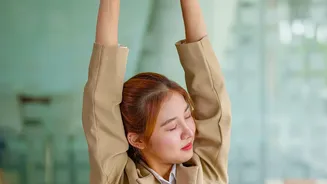
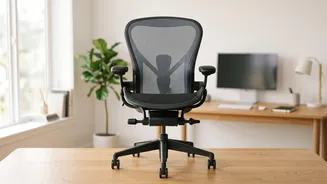
Sitting for long periods often causes us to hunch forward, leading to a stiff and rounded upper back. The thoracic extension is a perfect counter-movement. While sitting, place your hands behind your head or across your chest. Gently lean your upper back over
the top of your chair, allowing your chest to open. Look slightly upward without straining your neck. Hold this gentle arch for about 20 to 30 seconds, breathing comfortably. This exercise helps improve mobility in your upper and middle back, reducing stiffness and encouraging a more upright posture.
2. Seated Spinal Twist
A desk job rarely requires us to rotate our spine, which can lead to rigidity. A seated spinal twist is an excellent way to reintroduce this healthy movement. Sit tall with your feet flat on the floor. To twist right, place your left hand on your right knee and your right hand on the back or side of your chair for support. Inhale to lengthen your spine, and as you exhale, gently rotate your torso to the right. Hold for a few deep breaths before slowly returning to the center and repeating on the other side. This movement can relieve back tension and even aid digestion.
3. Shoulder Shrugs and Rolls
Tension from typing and using a mouse often accumulates in the neck and shoulders. Shoulder rolls are a simple and effective way to release this stress. Sit or stand tall with your arms relaxed at your sides. Inhale and lift your shoulders up towards your ears, then exhale as you roll them back and down. Perform about 10 slow, deliberate rolls backward, then reverse the direction for another 10 rolls forward. This simple circular motion helps ease tightness in the upper back and shoulders.
4. Wrist and Finger Stretches
Repetitive typing and clicking can lead to strain in the wrists and forearms. To stretch your wrist flexors, extend one arm in front of you with the palm facing up. Use your other hand to gently pull your fingers down and back toward your body. Hold for 15-20 seconds, ensuring you feel a stretch but no pain. Then, flip your hand so the palm faces down and gently pull your fingers toward you to stretch the extensors on top of your forearm. Repeat on both sides to help prevent repetitive strain injuries.
5. Standing Hamstring Stretch
Chronic sitting keeps your hamstrings in a shortened position, which can lead to tightness and contribute to lower back pain. A standing stretch can help. While sitting on the edge of your chair, straighten one leg out in front of you, resting your heel on the floor with your toes pointing up. Keeping your back straight, gently lean forward from your hips until you feel a comfortable stretch along the back of your thigh. Hold this for 20-30 seconds without bouncing, then switch legs.
6. Neck Tilts and Rolls
Staring at a screen often leads to a forward-head posture, straining your neck muscles. To relieve this, sit up straight and gently tilt your head toward your right shoulder, holding for 15-30 seconds. Be careful not to raise your shoulder to meet your ear. Slowly return to the center and repeat on the left side. You can also gently drop your chin to your chest and slowly roll your head from side to side to release tension in the back of your neck.
7. Chair Squats
Sitting for hours deactivates the largest muscles in your body: your glutes. Chair squats are a functional exercise that builds lower body strength for daily movements like sitting and standing. Stand in front of a stable chair (one without wheels). Lower yourself as if you are about to sit, keeping your chest lifted, until you lightly tap the chair. Immediately stand back up. Aim for 10-15 controlled repetitions. This engages your quads, hamstrings, and glutes, improving blood circulation after long periods of being sedentary.