




Beyond the Six-Pack: Redefining Core Strength
When we think of 'core strength', images of a sculpted six-pack often come to mind. But a truly strong core is much more than what you see on the surface. It's a complex system of muscles that includes the deep transverse abdominis, the obliques along
your sides, the pelvic floor, and even your lower back and diaphragm. This muscular network acts as your body's central stabilizer, protecting your spine, improving posture, and providing the foundation for almost every movement you make. Unlike traditional ab exercises that often isolate one muscle group (the rectus abdominis), yoga builds functional strength, training these muscles to work together in harmony.
The Power of the Pause: Why Holding Poses Works
The secret to yoga’s effectiveness lies in the principle of isometric contraction—engaging a muscle without changing its length. When you hold a yoga pose like Plank, your core muscles must fire continuously to maintain stability. This sustained engagement builds muscular endurance and deep strength in a way that dynamic, repetitive movements often miss. Holding a pose gives you time to focus on proper alignment and connect with your breath, which is crucial for deep core activation. It moves the practice beyond simple exercise, turning it into a mindful exploration of stability and strength that helps you remain calm and focused even when challenged.
Pose 1: Plank Pose (Phalakasana)
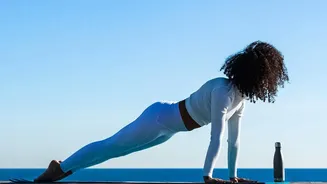
Plank is the quintessential core-strengthening pose for a reason: it engages your entire core unit, from your abdominals to your back and shoulders. To practice, start on all fours, then step your feet back until your body forms a straight line from your head to your heels. Actively press the floor away, pull your belly button toward your spine, and engage your glutes. Avoid letting your hips sag or rise too high. Beginners can start by holding for 20-30 seconds, focusing on maintaining a straight line. For an easier modification, lower your knees to the mat while keeping your core engaged.
Pose 2: Boat Pose (Navasana)
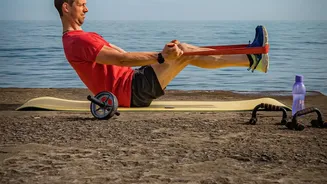
Boat Pose is a powerful seated posture that directly targets the abdominal muscles while challenging your balance. Sit on the floor with your knees bent and feet flat. Lean back slightly, keeping your spine straight, and lift your feet off the floor. Engage your core to keep your chest lifted. You can keep your knees bent in a V-shape or, for a greater challenge, straighten your legs. Extend your arms parallel to the floor. The key is to avoid rounding your back. If you feel your lower back straining, hold the backs of your thighs for support. This pose outperforms sit-ups by building stability across a wider range of muscles.
Pose 3: Bridge Pose (Setu Bandhasana)
While often seen as a gentle backbend, Bridge Pose is an excellent and accessible way to strengthen your core, glutes, and lower back. Lie on your back with your knees bent, feet flat on the floor hip-width apart, and arms alongside your body. Press into your feet and lift your hips off the floor. Keep your thighs parallel and engage your core to prevent your lower back from arching excessively. This pose strengthens the posterior chain, a critical part of your overall core system that supports posture and stability. You can even place a block between your thighs to deepen the engagement of your inner thighs and pelvic floor.
The Crucial Role of Breath
In yoga, the breath is the engine that powers the pose. As you hold these core-strengthening postures, your breathing should remain steady and deep. A powerful technique is to focus on your exhalation to deepen the core engagement. As you exhale, consciously draw your lower belly in and up, as if zipping up a tight pair of jeans. This action helps activate the deep transverse abdominis, your body’s natural corset. Focusing on the breath not only stabilizes the mind but also ensures your core muscles are working efficiently to support you from the inside out.