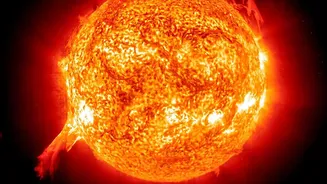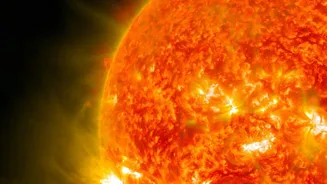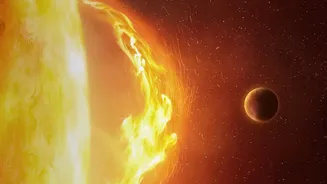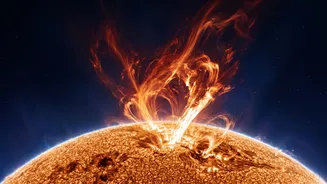

In a landmark achievement for space science, India's ISRO and the European Space Agency (ESA) have joined forces. Their solar missions, Aditya-L1 and Proba-3, just delivered the first-ever joint analysis of a solar outburst.
A Landmark International Collaboration
Scientists from the Indian
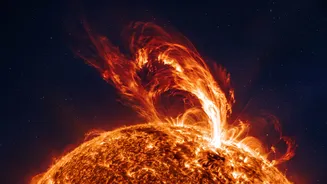
Institute of Astrophysics (IIA), Bengaluru, have released a groundbreaking analysis by combining data from two of the most advanced solar observatories in space: ISRO's Aditya-L1 and ESA's Proba-3. This partnership marks a new era of international cooperation in space, leveraging the unique strengths of each mission to achieve something neither could do alone. The joint study focused on Coronal Mass Ejections (CMEs), which are colossal eruptions of plasma and magnetic fields from the Sun's atmosphere. By observing the same solar events simultaneously, the two missions have provided an unprecedentedly detailed picture of how these powerful outbursts are born. The formal cooperation agreement between ISRO and ESA was recently extended, specifically including space weather as a key area, paving the way for such synergistic science.
India's Eye on the Sun
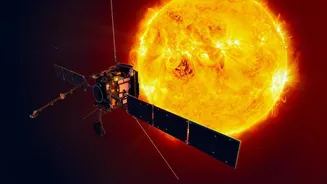
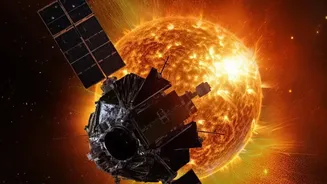
At the heart of India's contribution is the Aditya-L1 spacecraft, the nation's first dedicated solar observatory. Stationed at the Sun-Earth Lagrange Point 1 (L1), about 1.5 million kilometres from Earth, it has an uninterrupted view of the Sun. Its primary instrument for this study is the Visible Emission Line Coronagraph (VELC). A coronagraph is a special telescope that blocks the blinding light from the Sun's main disk, allowing scientists to see the much fainter outer atmosphere, or corona. VELC is special because it can see extremely close to the Sun's surface and also perform spectroscopy, which analyses the properties of light to determine the speed, temperature, and density of the coronal plasma. This gives scientists vital clues about how a CME is moving, not just across the sky, but towards or away from us.
Europe's Artificial Eclipse
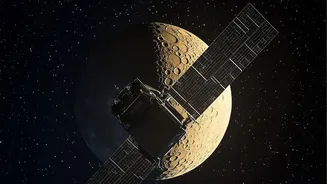
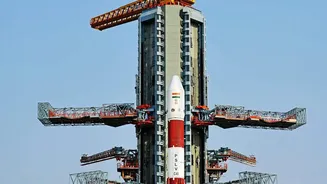
The ESA's Proba-3 is not just one spacecraft, but two, flying in perfect formation about 150 meters apart to create a giant, virtual coronagraph in space. One spacecraft acts as the 'occulter', casting a precise shadow onto the second 'coronagraph' spacecraft. This innovative setup mimics a total solar eclipse, allowing for incredibly clear views of the inner corona without the diffraction issues that can plague single-spacecraft coronagraphs. By creating these artificial eclipses for hours at a time, Proba-3 can capture the very first moments of a solar outburst with exceptional clarity, filling a critical gap in our observational capabilities. ISRO played a key role in this mission even before this joint analysis, having launched the Proba-3 mission on its PSLV rocket.
Seeing the Whole Picture
Observing the birth of a CME has always been a major challenge. While some telescopes can see the event after it has already erupted, seeing its origin requires peering into the Sun's inner corona, a region that is notoriously difficult to observe. The synergy between Aditya_L1 and Proba_3 solves this problem. Proba_3's formation flying provides the crystal_clear view of the eruption's ignition point, while Aditya_L1's VELC provides the crucial spectroscopic data, measuring the speed and direction of the ejected plasma. The first joint analysis studied two CMEs observed in September 2025. One was a fast_moving event at about 645 km/s, while the other was much slower at 145 km/s. For the first time, scientists could track these events seamlessly from their cradle near the Sun's surface out into the wider corona.
Why This Matters for Earth
This research is far more than just an academic exercise. CMEs are the primary drivers of space weather, which can have significant impacts on our planet. A CME directed at Earth can disrupt telecommunications, damage satellites, threaten astronauts, and even destabilise power grids. Understanding how these eruptions begin and accelerate is the first step toward accurately predicting their arrival and intensity. By combining the imaging prowess of Proba_3 with the spectroscopic diagnostics of Aditya_L1, scientists can better constrain their models of CME evolution. This landmark India–Europe collaboration not only elevates our scientific understanding of any Sun but also enhances our ability to protect our technology–dependent society from its most violent outbursts. It showcases India’s growing role as a major partner in cutting–edge global space exploration.