







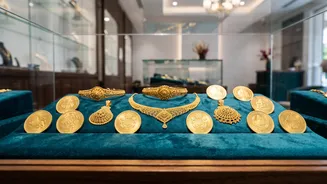
Dhanteras, falling on November 6, 2026, is the traditional day to welcome prosperity by buying gold. But festive excitement can be confusing. To ensure your investment is sound, it’s vital to understand exactly how that final price is calculated.
Step 1: Check the Correct Gold Rate
The first
component is the base rate of gold, which changes daily. Jewellers' associations in major cities declare the rate each morning. Remember, the price you see advertised is usually for 24-karat (24K) gold, which is 99.9% pure. However, most jewellery is made from 22K or 18K gold because pure gold is too soft. 22K gold, for example, is 91.6% pure gold (often marked as '916'). Always confirm the day's rate for the specific purity (karat) of the jewellery you are buying. The price for 22K gold will be lower than for 24K gold.
Step 2: Calculate the Base Gold Value
Once you know the rate, the next step is simple multiplication. The price of the gold in your chosen piece is the weight of the gold multiplied by the rate for its purity. For example, if the 22K gold rate is ₹6,500 per gram and your chain weighs 10 grams, the base gold value is ₹65,000 (10g x ₹6,500/g). When buying studded jewellery, ensure the jeweller weighs only the gold. Stones should be weighed and billed separately; otherwise, you risk paying the price of gold for less valuable stones.
Step 3: Understand Making and Wastage Charges
This is where pricing gets complex. 'Making charges' are the labour costs for crafting the jewellery. 'Wastage charges' account for the small amount of gold lost during the manufacturing process. Some jewellers combine these, while others list them separately. These charges can be a fixed rate per gram (e.g., ₹500/gram) or a percentage of the gold's value (ranging from 5% to over 25%). Intricate, handcrafted designs have higher charges than simple, machine-made pieces. Always ask the jeweller to break down these costs clearly. While wastage is an accepted industry practice, typical rates are between 2% and 15%, so question anything significantly higher.
Step 4: Add Hallmarking Fees
Mandatory hallmarking guarantees the purity of your gold. The Bureau of Indian Standards (BIS) oversees this process. As of a revision on September 14, 2026, jewellers pay a fee of ₹75 per gold article to the Assaying and Hallmarking Centre (AHC). This is a fixed fee per item, not based on weight, meaning a light ring and a heavy necklace can have the same hallmarking charge. While this cost is borne by the jeweller, it is factored into the final price you pay. The hallmark itself consists of the BIS logo, the purity grade, and a six digit alphanumeric HUID (Hallmark Unique Identification) number.
Step 5 : Calculate the Final GST
The final component is the Goods and Services Tax (GST). In India, a $3$% GST is applied to the value of the gold. Critically, this tax is not just on the gold value but on the total of the gold value plus the making and wastage charges. Some invoicing methods might show a $3$% GST on the gold value and a $5$% GST on making charges if billed as a separate service, but for a final jewellery piece, a composite $3$% on the total value before tax is standard practice. Always check that the GST is calculated on the correct subtotal.
Putting It All Together : A Price Breakdown Example
Let’s calculate the final price for a $10$-gram , $22$K gold chain , assuming the $22$K rate is ₹$6$,$500$/gram and making charges are $15$% . . . $1$. Gold Value : $10$ grams x ₹$6$,$500$/gram = ₹$65$,$000$ . . . $2$. Making Charges : $15$% of ₹$65$,$000$ = ₹$9$,$750$ . . . $3$. Hallmarking Charge : ₹$75$ . . . $4$. Sub$-$total (before tax) : ₹$65$,$000$ + ₹$9$,$750$ + ₹$75$ = ₹$74$,$825$ . . . $5$. GST : $3$% of ₹$74$,$825$ = ₹$2$,$244$.$$75$ . . . Final Billable Price : ₹$74$,$825$ + ₹$2$,$244$.$$75$ = ₹$77$,$069$.$$75$ . . . This step$-$by$-$step calculation demystifies the final price , allowing you to compare offers and ensure transparency from the seller.