


A Solution Born from Crisis
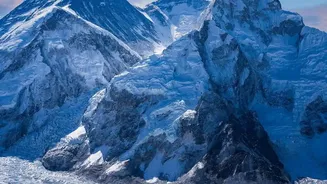
In Ladakh, life is dictated by the flow of water. For generations, farmers have relied on glacial melt to irrigate their crops. But with climate change accelerating glacial retreat, that life-giving water arrives too late in the year, long after the spring
planting season has begun. Faced with this growing crisis, engineer and innovator Sonam Wangchuk conceived of a revolutionary idea. He was inspired by seeing a patch of ice that survived late into the spring simply because it was shaded under a bridge. This led to a key insight: what if you could store the abundant, unused water of the winter and release it exactly when it's needed most? The answer was the ice stupa, an artificial glacier designed for the people.
The Simple Science of Artificial Glaciers
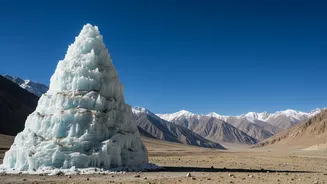
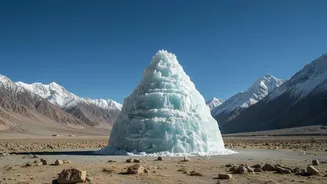
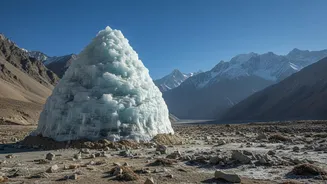
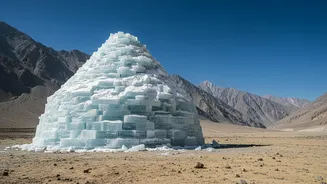
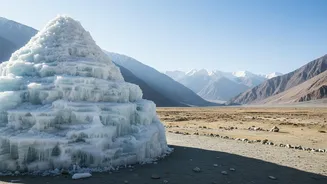
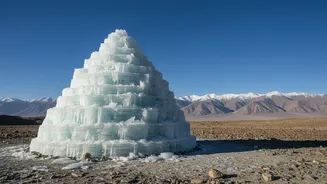
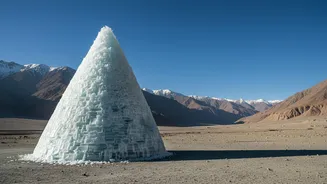
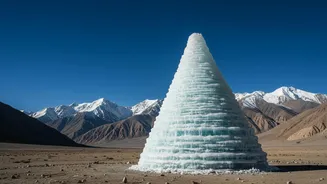
The genius of the ice stupa lies in its elegant simplicity. No pumps or electricity are required. The system works entirely on gravity. A pipe is laid from a stream at a higher altitude, running downhill to the village. The natural water pressure created by the elevation drop forces the water up through a vertical pipe, where it sprays out from a sprinkler into the frigid winter air. The sub-zero temperatures, which can drop below -20°C, instantly freeze the water droplets. Over the winter months, this process builds a massive, cone-shaped mountain of ice, closely resembling the sacred Buddhist stupas that dot the Ladakhi landscape, hence the name.
Why a Cone Shape Matters
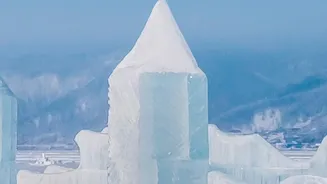
The conical shape is not just symbolic; it's a critical design feature rooted in physics. Wangchuk’s innovation improved upon earlier attempts at creating artificial horizontal glaciers, which had large surface areas and melted too quickly in the sun. A vertical cone, by contrast, exposes the minimum possible surface area to the direct sunlight and wind. This geometric efficiency allows the ice stupa to remain frozen long into the spring and early summer, well after the surrounding snow and ice have disappeared. The first prototype, built in 2014, stored 150,000 litres of water and lasted until mid-May, proving the concept's viability.
From Ice to Irrigation
As temperatures rise in April and May—the crucial sowing season—the stupa begins to melt. It slowly releases a steady stream of water, which is channelled through a network of ditches to irrigate fields of barley, potatoes, and poplar trees at the exact moment farmers need it. A single large ice stupa can hold millions of litres of water, enough to irrigate vast areas and support thousands of newly planted trees. This timely water supply not only saves the current year's crops but also enables villagers to reclaim barren land, effectively greening parts of the desert and securing livelihoods.
A Symbol of Hope and Adaptation
Since the first successful prototypes, the ice stupa movement has grown significantly, with dozens of structures now being built across Ladakh and even gaining international attention. The project, driven by Wangchuk's NGO, the Students' Educational and Cultural Movement of Ladakh (SECMOL), is a community-led effort that empowers locals to become active participants in solving their own problems. While proponents acknowledge that ice stupas are a form of adaptation rather than a cure for climate change, they serve as a powerful symbol. They demonstrate how local knowledge, scientific principles, and community action can create resilient solutions in the face of global environmental challenges, offering a blueprint for other mountain regions facing similar threats.