

A Material Revolution
For decades, the story of Indian couture was written in threads of gold, silk, and cotton. It was a world of masterful zardozi, delicate chikankari, and vibrant bandhani, where the richness of fabric and the density of embellishment defined luxury. But
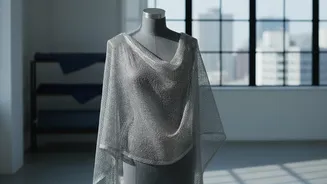
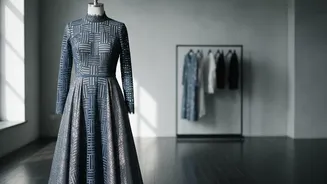
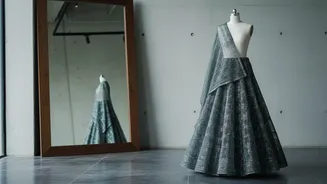
today, a new chapter is being forged, quite literally, from materials once reserved for industry and architecture. Designers are challenging conventions by turning to steel wires, recycled polymers, and metallic cords, transforming these unyielding elements into fluid, breathtaking garments. This shift isn't just about novelty; it's a fundamental re-engineering of the couture process, where the material itself, not just the decoration on its surface, creates the form and narrative of the garment. This new approach marries futuristic vision with artisanal precision, proving that the soul of couture lies in innovation as much as tradition.
The Sculptors of Form
At the forefront of this movement are designers who think like architects and sculptors. Gaurav Gupta has become globally recognized for his celestial, swirling gowns that seem to defy gravity. His signature is the sculpted drape, creating waves and spirals of fabric that ripple around the body, often using internal structures to achieve their gravity-defying forms. Similarly, Amit Aggarwal has built his brand on a foundation of material innovation, using recycled polymer sheets, rubber, and other industrial by-products to create architectural silhouettes. He masterfully cords metallic polymer strips and fuses them with traditional hand-embroidery, creating lehengas and gowns that are a dialogue between the old and the new, the organic and the industrial. His work is a testament to sustainable innovation, turning discarded materials into desirable high fashion.
Weaving with Steel
Perhaps no one has pushed the boundaries of material further than Rimzim Dadu. She is celebrated for her pioneering work with hair-thin steel wires, which she transforms into wearable, fabric-like textiles. What sounds rigid and unyielding becomes, in her hands, a material with a liquid-like sheen and incredible softness. Her iconic steel wire sari, which first gained international attention in 2016, looks like molten metal poured over the body. In recent collections, she has continued to experiment, embedding hand-cut mother-of-pearl into her signature steel textiles to create an interplay of strength and fragility. This process of deconstruction and re-engineering—breaking a material down to its core and building it back up into something completely new—is central to her design philosophy and represents the pinnacle of this new textural movement.
Lace and Embroidery Reimagined
The innovation isn't limited to industrial materials. Even traditional elements like lace and embroidery are being given a sculptural, three-dimensional makeover. Designers like Rahul Mishra, known for his painterly 3D embroidery, create entire ecosystems on fabric, with flora and fauna that literally pop off the garment. His work is a form of 'slow fashion', taking thousands of hours to create textural, lifelike motifs that tell a story. Elsewhere, designers like Isha Jajodia of ROSEROOM are exploring corded and guipure laces, using them to create structured corsetry and sculpted silhouettes that balance romance with a powerful structure. By layering these textiles and combining them with new embellishments like hand-moulded clay, they are pushing lace beyond its traditional role as delicate trim and turning it into a primary structural component.
A New Indian Identity
This embrace of sculptural forms and unconventional materials signals more than just a passing trend. It represents a confident evolution in Indian fashion's identity on the global stage. For years, Indian design was often seen through a singular lens of ornate, traditional craft. While celebrating this heritage, the new vanguard is proving that Indian couture is not a monolith. It can be futuristic, rebellious, and abstract. These designers are moving beyond surface embellishment to innovate on the very structure and soul of the garment. By merging industrial materials with meticulous hand-craftsmanship, they are creating a new language for luxury—one that is forward-looking and globally resonant, yet deeply rooted in a culture of artisanal excellence. It's a vision of Indian couture that is as much about form and texture as it is about thread and textile.