








What is Low-Earth Orbit?
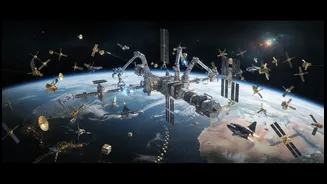
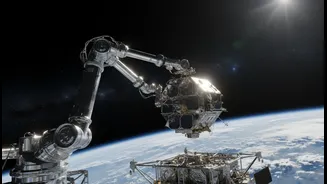
Think of Low-Earth Orbit, or LEO, as the most accessible and valuable real estate in space. It's a region stretching from about 160 to 2,000 kilometres above our planet. For decades, it was primarily the domain of the International Space Station (ISS),
spy satellites, and scientific missions. Its proximity to Earth makes it ideal for many applications because it allows for lower-latency communications and higher-resolution imagery compared to satellites in more distant orbits. This accessibility, combined with falling launch costs driven by private innovation, has set the stage for a commercial gold rush.
The New Gold Rush: Connectivity
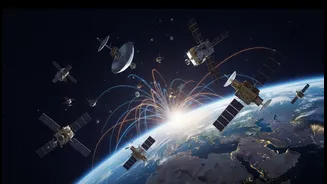
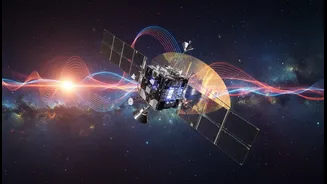
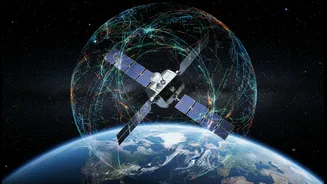
The most significant driver of the LEO business boom is the race to provide global, high-speed internet. Companies like SpaceX's Starlink, Eutelsat OneWeb, and Amazon's Project Kuiper are deploying vast constellations of thousands of satellites. Starlink already has over 7,000 satellites in orbit, dwarfing its competitors and providing internet to remote farms, construction sites, and rural communities where terrestrial broadband is unavailable. With a projected market for LEO services set to grow from around $16 billion in 2025 to $120 billion by 2030, a huge portion of this is driven by the demand for connectivity that will power everything from retail point-of-sale systems to the next wave of the AI economy.
Eyes on Earth: Data and Observation
Beyond internet access, another major business segment is Earth observation. More than 1,200 commercial imaging satellites are currently in LEO, capturing high-resolution data for a vast range of industries. This data is invaluable for applications in agriculture (monitoring crop health), climate change tracking, disaster management, and urban planning. The market for LEO remote sensing imagery and data services was valued at over $4 billion in 2025 and is projected to grow significantly as businesses find new ways to leverage this constant stream of information from above.
Factories in the Sky
A more futuristic but rapidly advancing frontier is in-space manufacturing. The microgravity environment of LEO offers unique advantages for producing materials and products that are difficult or impossible to make on Earth, such as flawless fiber-optic cables, superior semiconductor crystals, and complex bioprinted tissues. NASA's plan to transition from the government-owned ISS to commercially operated space stations by 2030 is a major catalyst. Companies like Axiom Space are already building modules for the ISS that will eventually form a free-flying commercial station, providing a platform for research and manufacturing. NASA recently confirmed it is moving forward with its plan to procure services from these commercial stations, a major vote of confidence in the private sector.
India's Stake in the LEO Economy
India is positioning itself to be a key player, not just a customer, in the LEO economy. The Indian government's 2020 space sector reforms and the establishment of IN-SPACe have opened the doors for private enterprise. This has spurred a wave of over 150 space-tech startups. Companies like Skyroot Aerospace are developing private rockets, while others focus on building satellites and ground infrastructure. Global players are also making inroads; Eutelsat OneWeb, part-owned by India's Bharti Group, is already a major LEO operator, and Reliance is reportedly exploring a multi-billion dollar entry into the sector. This push is critical for connecting the 20-25% of India's population in areas without terrestrial internet and for driving the Digital India mission.
The Challenge of a Crowded Sky
This rapid commercialisation is not without its challenges. The explosion in the number of satellites—projected to be over 100,000 in the next decade—raises serious concerns about orbital congestion and space debris. A collision in LEO could create a cascade of debris that threatens all other satellites. Navigating complex regulations, securing investment, and managing the short operational lifespan of LEO satellites (typically 5-7 years) are significant hurdles for businesses. As the sky gets busier, establishing sustainable practices and international coordination will be crucial for the long-term viability of the LEO economy.