



From Fuzzy Ears to Icy Discs
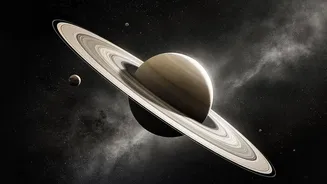
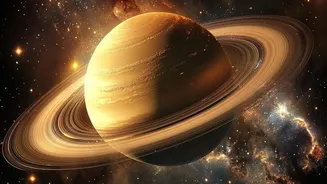
When Galileo Galilei first pointed his telescope at Saturn in 1610, he didn't see rings. He sketched what looked like a planet with two large moons or 'ears' on either side. It wasn't until 1655 that Dutch astronomer Christiaan Huygens, with a more powerful
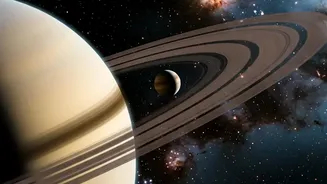
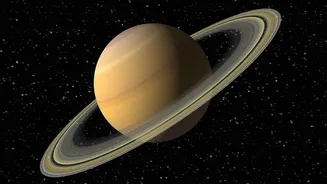
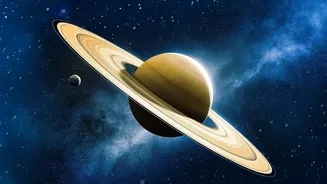
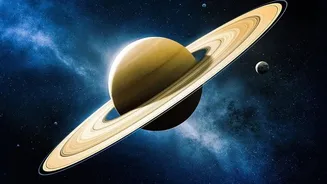
telescope, correctly identified them as a solid, flat disc encircling the planet without touching it. Later, Giovanni Cassini discovered a major gap, now named the Cassini Division, suggesting the rings were not a single object but were split into at least two parts. For the next 300 years, this was largely our picture of Saturn: a planet with a few broad, solid, and likely ancient rings made of unknown material. This Earth-based view portrayed a static and simple system, a peaceful celestial ornament.
Pioneer 11's Quick Hello
Our understanding took its first robotic leap in September 1979, when NASA's Pioneer 11 spacecraft flew past Saturn. Acting as a trailblazer for future missions, Pioneer 11 gave humanity its first-ever up-close look. The mission's low-resolution images confirmed the major ring structures but also delivered surprises. It discovered a new, thin, outermost ring, designated the 'F' ring. Pioneer 11 also found that the dark gaps in the rings, which looked empty from Earth, actually contained material. By passing under the ring plane, it provided a new perspective and crucial data that proved spacecraft could safely navigate the complex environment, paving the way for the missions that would follow.
Voyager Unveils the Chaos
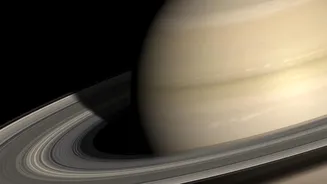
If Pioneer 11 opened the door, the twin Voyager 1 and 2 spacecraft blew it off its hinges in 1980 and 1981. The serene, solid rings of old were replaced by a vision of staggering complexity. The Voyagers revealed that the main rings were not a few broad bands, but an intricate system of thousands of individual ringlets, like grooves on a record. They discovered strange, dark, radial features in the B ring, dubbed 'spokes,' that formed and dissipated over hours. The newly discovered F ring was even stranger, appearing to be composed of multiple, braided strands held in place by tiny 'shepherd' moons. The Voyagers showed that the rings were not a static structure but a dynamic system, shaped by the gravitational pulls of Saturn's many moons.
Cassini's Thirteen-Year Vigil
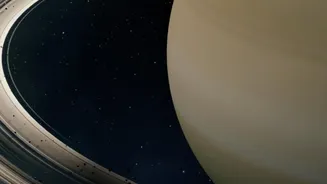
The Cassini-Huygens mission, which orbited Saturn from 2004 to 2017, represents the pinnacle of our ring exploration. Instead of a quick flyby, Cassini spent 13 years observing the system, witnessing seasonal changes and uncovering phenomena previous missions couldn't. It discovered tiny moonlets, called 'propellers,' creating wakes within the rings. During Saturn's equinox, when sunlight hit the rings edge-on, Cassini saw shadows revealing that some ring particles clump together to form vertical structures as tall as mountains. The mission found that the rings have their own tenuous atmosphere of oxygen and that icy material from the rings is 'raining' down onto Saturn's atmosphere. Cassini's close-up views showed a system that was far more active and interconnected with its moons than ever imagined.
A Fleeting Cosmic Spectacle
Perhaps Cassini's most profound discovery came from data collected throughout its mission, which allowed scientists to determine the rings' mass and age. For years, it was assumed the rings were as old as Saturn itself, about 4.5 billion years. However, by measuring the rate at which interplanetary dust has 'polluted' the pristine water ice of the rings, studies have concluded they are shockingly young. Current estimates place their age at no more than 100 to 400 million years old, meaning they likely formed when dinosaurs still roamed the Earth. Furthermore, Cassini's data confirmed that the rings are disappearing, with tons of material falling into the planet every second. They may only last for another few hundred million years, a cosmic blink of an eye.